In 2025, the work day stretched. Calendars loosened. The edges got blurry.
At the same time, our attention got diced up.
On paper, flexibility looks like progress. In practice, it’s easy to lose the thread. Freedom without a frame turns into drift—one context switch, one “quick” meeting, one urgent ping at a time.
We surveyed Sunsama customers and alumni about focus, availability, burnout, and the small habits that actually help. This is the story I think matters, and the simple playbook I’m taking into 2026.
If you want the full deck, download the 2025 report (PDF) here.
The 2025 headline stats
94% report flexible schedules (up from 90% in 2024). Only 25% feel productive most days.
79% say their biggest struggle is some flavor of fragmented focus: deciding what to do, switching contexts, or sheer workload.
67% feel pressure to be always available.
49% experience work stress or burnout often or very often.
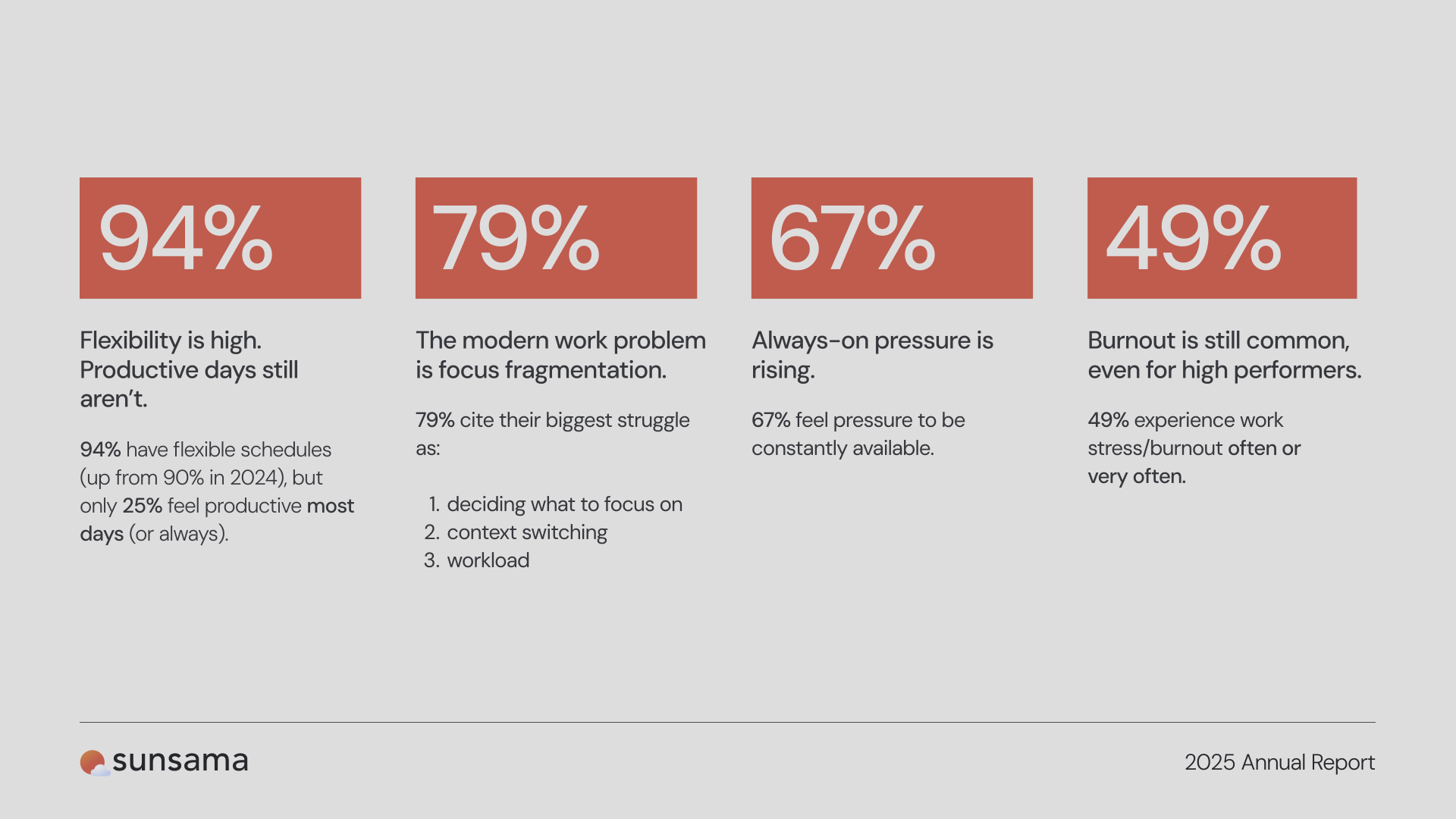
Flexibility is high. Productive days still aren’t.
We don’t need more freedom. We need a frame.
A flexible schedule without a plan feels good at 9am and vague at 4pm. The day slips. Work leaks. You end “busy” but unfinished.
What helps is simple: build structure inside the freedom. Make the open‑ended day feel closed‑loop by 5pm.
The modern work problem is focus fragmentation
When we asked people what’s hardest, three answers kept showing up:
- Deciding what to focus on (29%)
- Context switching (26%)
- Overwhelming workload (24%)
You can work “reasonable” hours and still feel cooked. It’s not just volume. It’s fragmentation. Attention gets shredded and never fully recovers mid‑day.
.png)
Urgency is deciding the day—and burnout follows.
Many teams “prioritize” by reacting. It feels efficient. It isn’t.
34% say they pick whatever’s most urgent in the moment. That urgency‑first approach correlates with higher burnout (58% vs 45%).
Urgency moves the cursor. It doesn’t make the work matter. That “busy but behind” feeling? It’s what you get when the day decides for you.
.png)
The hopeful part: tiny rituals still beat big intentions
If fragmentation is the tax, don’t fight it with willpower. Use rituals. They’re small, repeatable, and they compound.
1) Plan the day, every day
People who plan daily are:
- 3× more likely to report productive days most of the time (28% vs 9%)
- 2× more likely to say work feels sustainable (52% vs 25%)
Planning is cheap. The benefits stack. One clear outcome, a short list, and honest estimates will carry you farther than a big ambition you revisit once a quarter.
.png)
2) End the day on purpose
A real shutdown routine correlates with lower burnout (41% vs 54%).
It doesn’t shrink your queue. It seals the edges. Close loops, capture loose ends, then stop. The next day is clearer because the previous day actually ended.
.png)
Where Sunsama fits
If the problem is fragmentation, the goal isn’t “do more.” It’s:
- Pick the right work.
- Make it realistic.
- Protect focus time.
- End the day clean.
That’s what Sunsama is built to do.
In the survey, Sunsama’s biggest reported impacts were:
- Clarity on what to focus on today (83%)
- A feeling of control over workload (70%)
.png)
What we’re taking into 2026
2026 will reward sustained focus, not heroic sprints.
A simple playbook (whether or not you use Sunsama):
- Decide the day before the day decides for you. Pick one meaningful outcome.
- Protect one pre‑lunch focus window. Treat it like leverage, not a luxury.
- End the day on purpose. Close loops. Capture loose ends. Stop.
Want the full story (and the charts)?
Want the full story and charts?
The full report digs into meetings, always‑on pressure, burnout patterns, and the habits that correlate with healthier work days.
Download the 2025 report here →