Feeling buried under constant pings and back-to-back meetings? Does your team’s “process” feel more like a tangled web of unspoken rules? You’re not alone.
This guide will walk you through how to define your team’s ways of working—the shared agreements that create clarity, protect focus, and make collaboration calm and predictable. We’ll cover how to establish core principles, roll them out gently, and adapt them for any team, no matter where they work.
What are ways of working?
Ways of working aren't a complex new system you need to buy. They are simply your team's shared agreements on how you communicate, collaborate, and get work done. Think of it as your team’s operating system—the foundational principles that guide everything else.
In a traditional office, many of these "rules" were unwritten. You absorbed them by observing others—when it was okay to tap a colleague on the shoulder, how formal a meeting needed to be, or where to find project updates.
But in a remote or hybrid world, that unspoken understanding evaporates. Without clear, intentional agreements, teams often slide into chaotic habits: constant notifications, endless meetings, and fuzzy ownership. This is a fast track to burnout. Defining your ways of working is the act of making those rules explicit, creating a calm and productive environment for everyone. This is more important than ever. A recent study by Apollo Technical found that well-structured remote work can actually boost productivity by up to 40%.
Core principles that actually matter
A good framework for ways of working answers a few simple questions:
- How do we communicate? (e.g., Slack for quick questions, async updates for project progress)
- How do we manage our work? (e.g., who assigns tasks, where do we track them)
- How do we meet? (e.g., what actually requires a live meeting vs. a document)
- How do we protect focus time? (e.g., meeting-free days, respecting "deep work" statuses)
Common models to draw from
While every team's system is unique, most are built on principles from a few established models. Think of these as a menu of ideas, not rigid prescriptions.
- Agile
- Core principle: Iterative progress in short cycles (sprints) with frequent feedback
- Best for: Software development and project teams with evolving requirements
- Potential challenge: Can become overly rigid with ceremonies if not adapted properly
- Async-First
- Core principle: Communication that doesn’t require an immediate response is the default
- Best for: Distributed teams across multiple time zones needing deep focus
- Potential challenge: Requires excellent documentation and can feel isolating if not balanced
- Kanban
- Core principle: Visualizing workflow to limit work-in-progress and maximize efficiency
- Best for: Teams with continuous workflows like support, content, or operations
- Potential challenge: Can hide larger bottlenecks if the board isn’t managed well
- Hybrid
- Core principle: A mix of in-office and remote work, with specific guidelines for each
- Best for: Companies transitioning from office-first culture to offer flexibility
- Potential challenge: Creating an equitable experience for both in-office and remote staff
The goal isn't to adopt one model wholesale. The magic happens when you pull the best parts to build your team's unique operating system. For example, making asynchronous communication the default can dramatically cut down on interruptions. If you want to dive deeper, our guide on what async work is is a great place to start.
How to design your ways of working: a step-by-step guide
Rolling out a new way of working shouldn't feel like flipping a switch into chaos. The goal is a calm, iterative process that makes your team part of the change. Here’s a practical, step-by-step guide.
1. Audit your current workflow Before you fix anything, find out what’s actually broken. Ask your team: Where do communication breakdowns happen? Which meetings feel like a waste of time? Where does work get stuck? Gather this intel through simple surveys or informal one-on-one chats.
2. Co-create the principles with your team Don’t impose new rules from the top down. Bring your team into the process. Lay out the friction points you uncovered, then run a brainstorming session. Ask them, "How can we solve this together?" This shifts them from being passive recipients to active owners invested in making it work.
3. Start with “forced thoughtfulness” At Sunsama, we believe in a principle called "forced thoughtfulness." It’s about taking a deliberate pause to ask the fundamental questions most teams skip. This isn't about creating red tape; it's about building a shared understanding that gives everyone more autonomy. A key part of this is defining what urgency really means. If everything feels urgent, nothing is.
4. Document everything in a simple playbook Get your core principles down in a central, easy-to-find playbook. This isn't a 50-page manual. It should be a concise guide outlining:
- Communication protocols (When to use Slack vs. email vs. async)
- Meeting etiquette (Purpose, agendas, and follow-ups)
- Task management standards (How work is assigned and tracked)
- Focus time policies (How to signal and respect deep work)
5. Pilot the new framework with a small group Don’t go for a big-bang launch. Test-drive your new framework with a small, willing group for a couple of weeks. This lets you iron out the kinks and collect feedback before a broader rollout. A pilot program minimizes risk and helps you build a success story that gets others excited.
Pro Tip: Start with Yourself The best way to lead change is to be the change. Before you ask anyone else to adopt new behaviors, practice them consistently in your own daily routine. Use a daily planner to organize your tasks, protect your focus blocks, and communicate your availability. Your team will follow your lead.
6. Choose tools that support your principles Technology should serve your ways of working, not the other way around. Once your principles are solid, pick tools that reinforce them. If protecting focus is a priority, find a tool that helps people manage their daily tasks and block out time for deep work. For example, a shared calendar is great for scheduling, but a daily planner like Sunsama helps each person thoughtfully structure their day.
7. Build a simple feedback loop Your new ways of working should be a living system. Schedule a quick "ways of working" check-in during your monthly team meetings or run a quarterly retrospective. Ask three simple questions: What’s working well? What’s not working? What should we try next? This ongoing conversation ensures your system adapts and improves.
Adapting for global and distributed teams
When your team is scattered across time zones, a smart approach to collaboration is essential. The biggest mistake distributed teams make is trying to copy an in-office, synchronous culture. The real solution is to lean into asynchronous communication as your default. For more on this, check out these remote work best practices for sustained success.
In a remote setting, documentation becomes your most valuable player. A central, well-organized knowledge base acts as a "single source of truth" that anyone can access, anytime. This isn't just about meeting minutes; it includes project briefs, process guides, and clear records of decisions. Solid documentation cuts down on interruptions and empowers people to find answers on their own.
A gentle counterpoint: Principles over process
It's easy to get caught up in building the "perfect" system with rigid rules and complex workflows. But often, the most effective ways of working focus on simple principles, not strict processes.
A process-heavy approach can become brittle and bureaucratic, creating more overhead than it saves. Principles, on the other hand, are flexible. They provide guardrails that empower your team to make smart decisions in the moment without consulting a manual. For instance, instead of a multi-step approval process for a document, a guiding principle might be: "Default to trust and ship quickly; we can always iterate." This focus on intentionality over rigidity is what creates a truly calm and effective work environment. These guardrails for your focus time are a good example.
How we do it at Sunsama
At Sunsama, our ways of working are built around a simple loop: triage, plan, and focus. This rhythm is embedded in how we use our own tool.
Each morning starts with a daily planning ritual. We pull tasks from our inboxes, Slack, and project management tools into our Sunsama list for the day. This isn't just about making a to-do list; it's a moment of forced thoughtfulness where we decide what truly matters today. We then timebox these tasks on our calendar, creating a realistic plan for the day ahead.
When it's time for deep work, we use Focus Mode, which silences notifications and updates our Slack status automatically. This simple habit signals to the team that we’re unavailable, protecting our most valuable resource: our attention. This whole system is designed to promote calm, focused work, not just endless activity.
The leader’s role in making change stick
A new framework is only as good as the leaders who live it. If managers don’t walk the talk, the whole effort will fizzle out. Your job is to embody the new principles so consistently that they become the team's natural rhythm.
This means being the first to default to an async update instead of calling a last-minute meeting. It means publicly blocking out focus time on your calendar and respecting when your team does the same. When you see someone falling back into old habits, don't just correct them—gently guide them. This kind of patient reinforcement is what rewires old habits without making people feel called out. For more ideas, see our guide for managers on fostering team productivity.
Measuring success without the noise
Think of your new ways of working as a living system. The goal isn't to chase abstract productivity numbers but to see if your team's quality of work-life is genuinely getting better.
Instead of complex dashboards, track a few meaningful indicators:
- Uninterrupted focus hours: Is the team getting more time for deep work?
- Meeting-to-work ratio: Is time spent in meetings decreasing relative to productive work?
- Team sentiment scores: Use simple surveys to ask, "On a scale of 1-10, how calm and focused did you feel this week?"
A quarterly "Ways of Working Retrospective" is the perfect place to discuss these trends. It’s a dedicated, blameless space to talk about what's helping, what's hurting, and what to try next. This simple, repeated process turns your framework from a stuffy set of rules into a shared, living practice. For a deeper look, our guide on productivity strategies and how to measure it offers more frameworks.
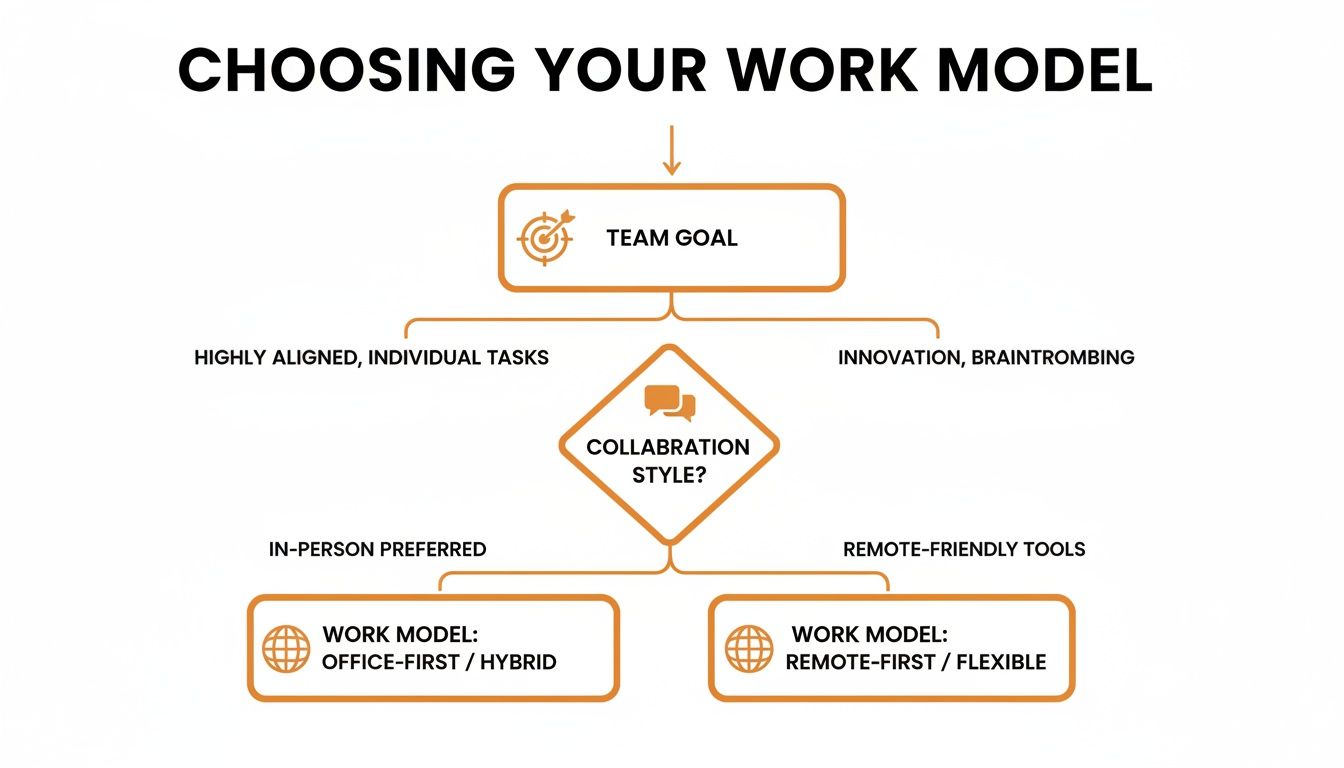
As this flowchart shows, the right choice flows directly from your team's foundational needs and goals—which you can only understand by regularly checking in.
Defining your ways of working gives your team a shared map, but each person still needs a compass to navigate their day. Sunsama helps turn high-level principles into a calm, focused daily practice by guiding you through a daily planning ritual.
Ready to build a calmer, more intentional workday? Start your free 14-day trial of Sunsama and build your perfect workday.