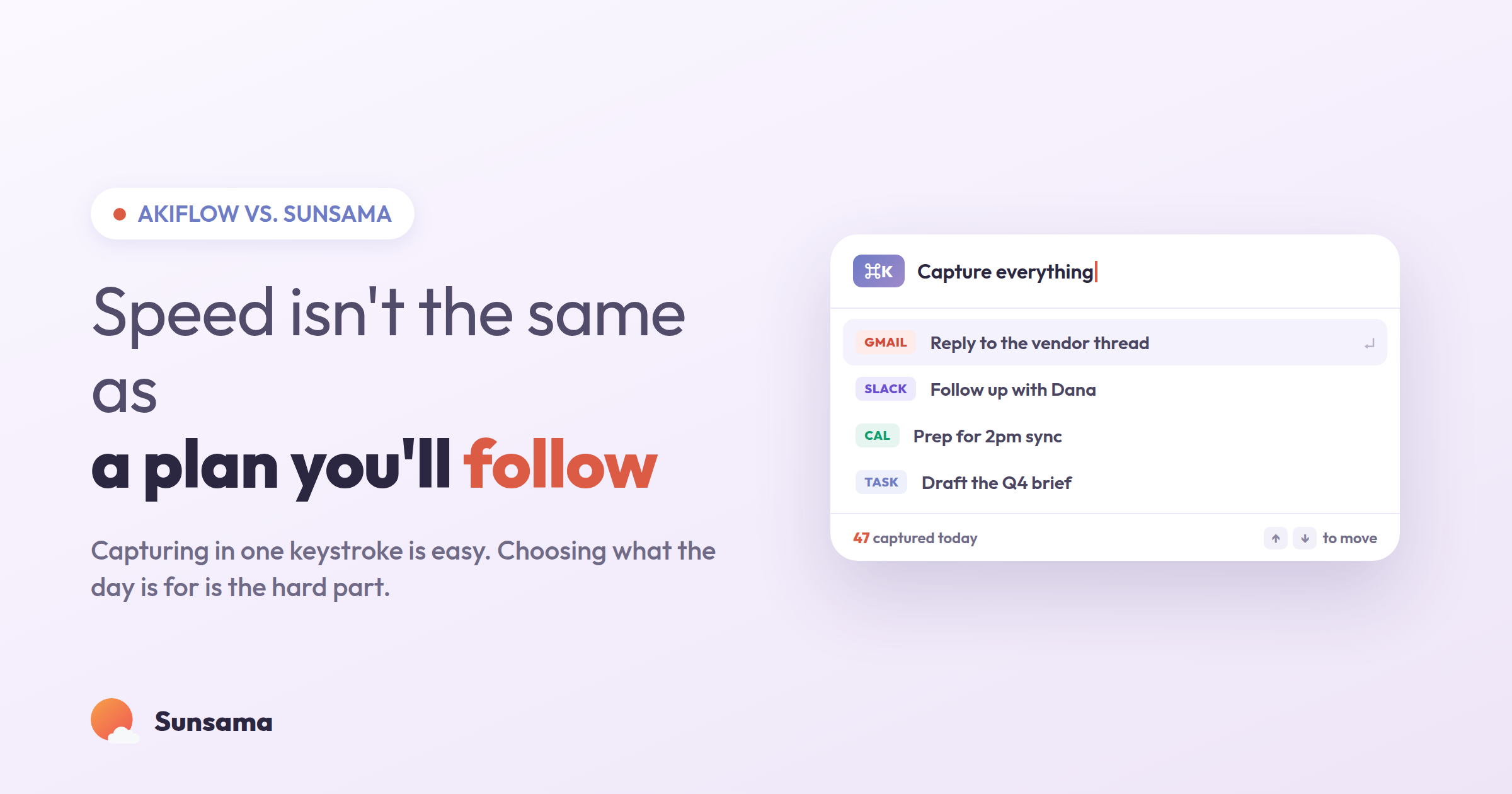
If you’ve ended up comparing Akiflow and Sunsama, you already know the real problem. It isn’t that your tasks are scattered — you’ve probably tried three apps that promised to gather them. It’s that even when everything is in one place, you still open your day unsure what actually belongs in it. Pulling tasks together is the easy part. Deciding what today can realistically hold is the part that quietly decides whether you finish feeling steady or frayed.
Both tools are built for people who’ve outgrown a plain list and want their work and calendar to live in the same view. They take genuinely different paths to get there, though, and the difference matters more than the feature grids suggest. One is built around speed — capture anything, from anywhere, in seconds. The other is built around a daily ritual that asks you to plan on purpose and stop on purpose. Neither is wrong. But they produce very different days.
This is an honest look at where each one fits, written by the team behind Sunsama. We’ll be clear about what Akiflow does well, because plenty of people are happy there. The goal is to help you pick the tool whose core habit matches the day you’re actually trying to have.
What each tool is really optimizing for
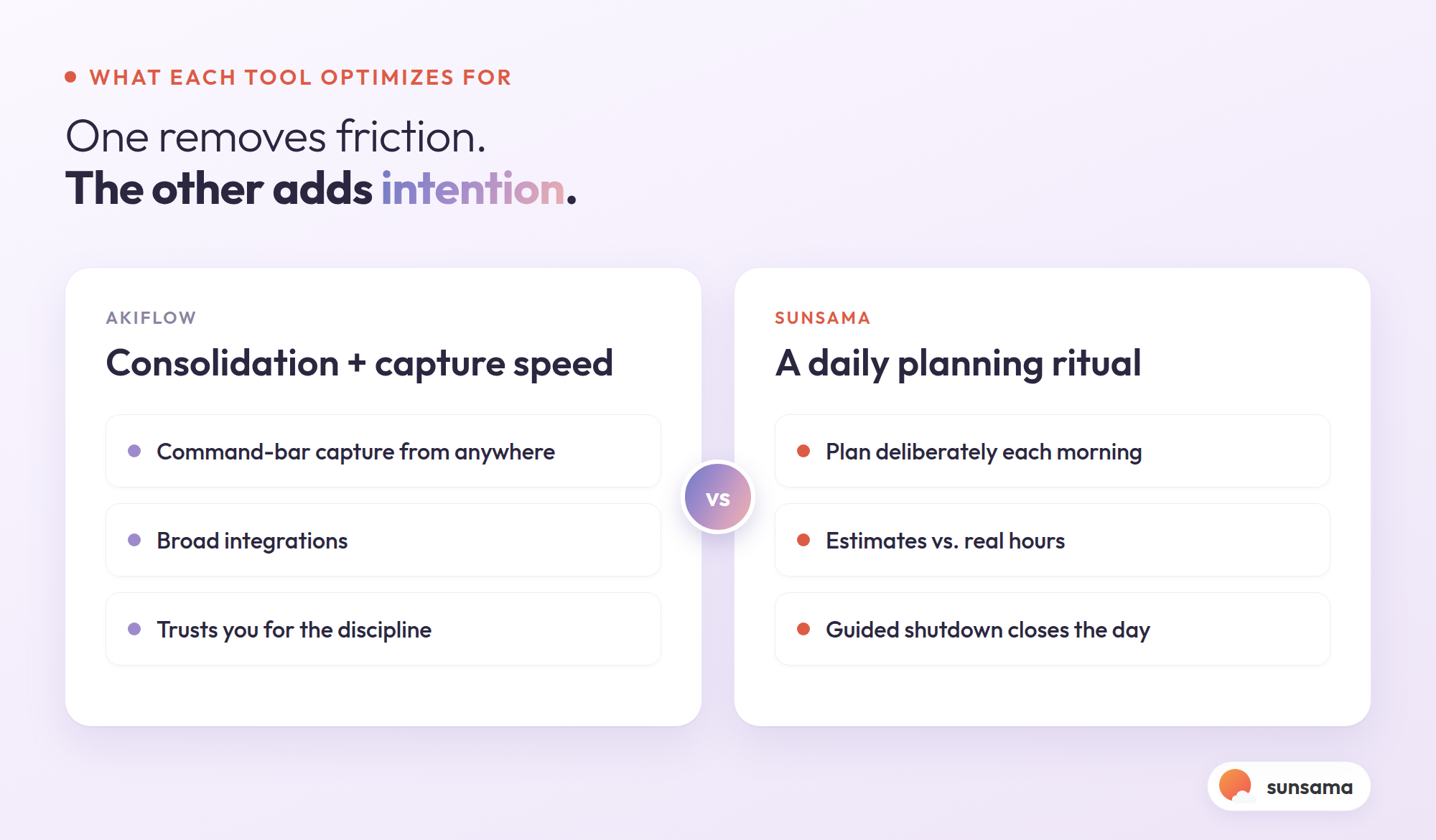
Akiflow’s center of gravity is consolidation and speed. It pulls tasks in from your other tools, gives you a command bar you can summon with a keyboard shortcut to capture or reschedule almost anything, and lets you drag items onto your calendar. The promise is that nothing slips through the cracks and that acting on your list costs you almost no friction. If your pain is “my tasks are everywhere and capturing them is annoying,” Akiflow is built precisely for that.
Sunsama’s center of gravity is the daily plan itself. It also brings your tasks and calendar together, but the heart of the product is a short, guided ritual: each morning you pull in only what you intend to do today, estimate how long each task will take, and lay it against the hours you actually have. At the end of the day there’s a matching shutdown that helps you close open loops and set up tomorrow. The promise isn’t speed. It’s that you plan a day you can finish, and then you let it end.
That difference — friction removed versus intention added — is the whole decision. Fast capture is wonderful right up until the moment your list is beautifully organized and still longer than any human day. A clean inbox doesn’t tell you what to do at 9 a.m. The underlying skill is deciding, and deciding is exactly where a calendar-backed daily plan earns its keep, the same way it does in classic time blocking.
Where Akiflow shines
Credit where it’s due. If you live across many systems and your main frustration is capture, Akiflow’s command bar is a real pleasure — summon it, type, done, without breaking focus. Its integrations are broad, and power users who love keyboard-driven everything will feel at home. For someone whose work is high-volume and reactive, and who mostly needs a fast, unified surface to triage from, that speed is the point.
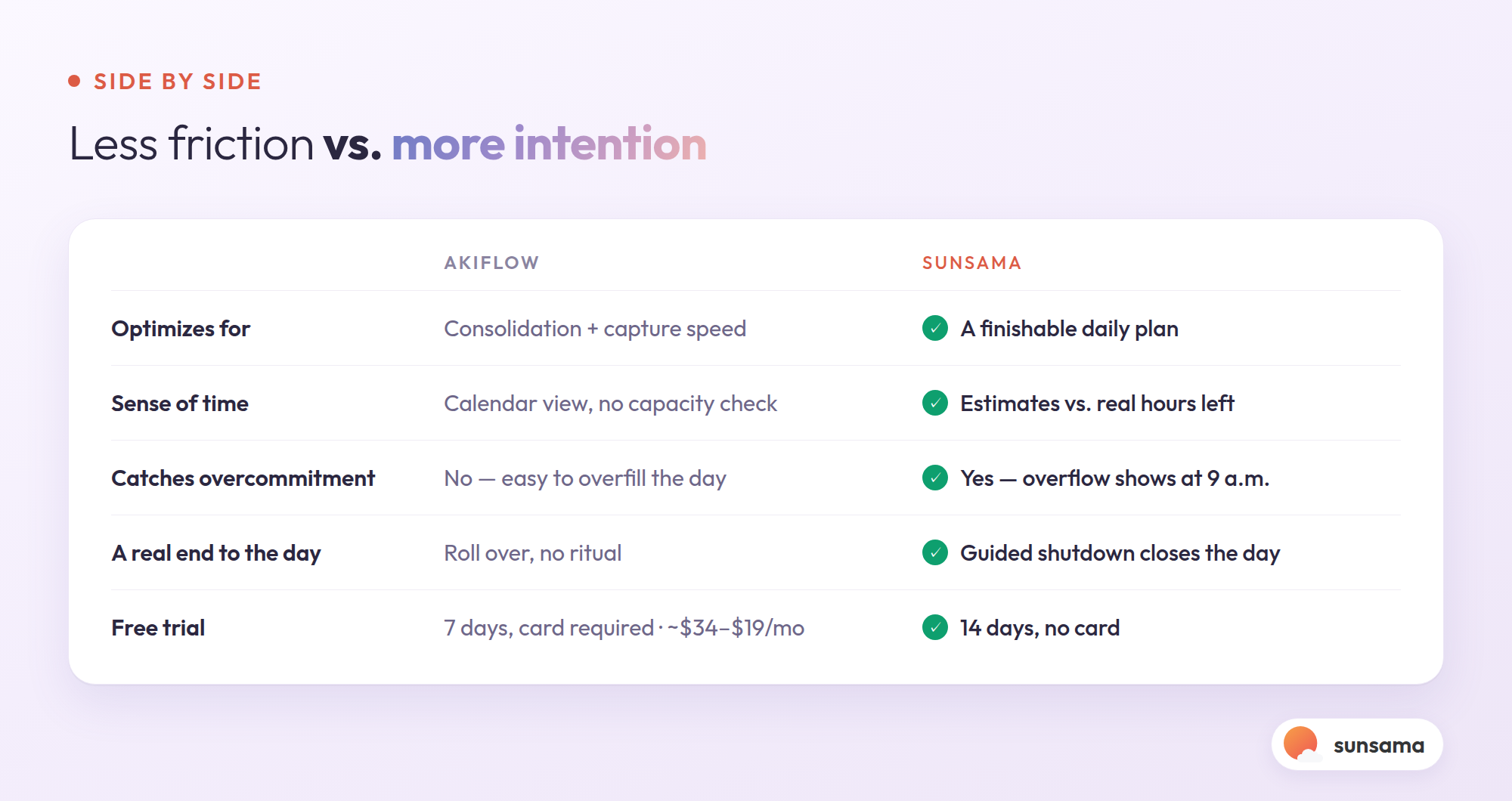
The trade-offs are worth naming plainly. Akiflow’s trial is 7 days and requires a card up front, and the standalone plan runs about $34/month billed monthly (dropping to roughly $19/month if you commit annually). More importantly, the tool trusts you to supply the discipline. It makes it effortless to schedule a task — and just as effortless to schedule twelve, overfill the day, and roll the overflow to tomorrow without ever noticing the day was impossible from the start. Speed removes friction in both directions. That’s the catch worth sitting with before you decide.
Where Sunsama is the better fit
Sunsama is the better fit when your problem isn’t capture — it’s commitment. When you have plenty of tasks and too little clarity. When your days quietly fill past what’s possible and you end up measuring yourself against a list no one could have finished. The product is opinionated on purpose, because the habit it’s protecting is the one most tools leave to willpower.
Three design choices carry that intent:
1. You plan the day deliberately, not just quickly. Each morning Sunsama walks you through choosing today’s work from your backlog and calendar. You’re not staring at everything; you’re deciding on a short, finishable set. It’s the daily-scale version of the thinking in our daily planning guide — less a dashboard to manage, more a small ritual that forces a real decision.
2. Time estimates make overcommitment visible before it happens. You add a rough estimate to each task, and Sunsama totals it against the hours you have left after meetings. When your plan adds up to eleven hours, you see it at 9 a.m. — not at 6 p.m. when it’s already a story about falling behind. Capturing a task fast doesn’t tell you it won’t fit. Estimating it does.
Try it in Sunsama: During your morning planning, add a time estimate to every task before you start working. Then look at the daily total next to your available hours. If it’s over, cut or move something now — while it’s a calm choice, not a late-night scramble.
3. The day is built to end. Sunsama’s shutdown ritual is a first-class feature, not a footnote. At the end of the day you review what got done, consciously roll over what didn’t, and set up tomorrow — then you’re meant to actually stop. For anyone drifting toward work-life imbalance, a defined finish line is often worth more than any amount of capture speed.
A simple way to choose
You don’t need a spreadsheet. You need to know which failure mode is yours.
Choose Akiflow if your honest answer is “my tasks are scattered and capturing or triaging them fast is my biggest friction,” and you already plan realistic days on your own. You’ll get a quick, unified command surface and you’ll supply the restraint yourself.
Choose Sunsama if your honest answer is “everything’s already in one place and I still overfill my days, measure myself against an impossible list, and can’t tell when to stop.” You’ll trade a little capture speed for a daily ritual that decides what’s realistic and a shutdown that lets the day close.
Here’s the test that cuts through it: think back over the last two weeks. If the recurring frustration was finding or adding things, lean Akiflow. If it was finishing them — or feeling like you never quite could — lean Sunsama. A faster way to add work to an already-overloaded day usually makes the real problem worse, not better. If what you want is a system that makes you feel productive without changing the outcome, that’s its own trap worth avoiding.
Try it in Sunsama: Start the free 14-day trial — no credit card required — and commit to just the morning planning ritual for one week. Don’t change anything else about how you work. Notice whether the number of tasks you finish goes up, even if the number you capture goes down.
Pro Tip: For your first week in Sunsama, deliberately under-plan. Choose fewer tasks than you think you can do and give each a slightly generous time estimate. Most people are chronically optimistic about their own capacity, and a day you actually complete rebuilds trust in your plan far faster than an ambitious one you abandon by noon. You can always pull in one more task from the backlog when you finish early — that feels completely different from clearing an overflow at midnight.
The honest bottom line
Akiflow and Sunsama are both good tools aimed at serious people, and the marketing-grid version of this comparison — who has which integration, whose shortcut is faster — mostly misses the point. The question that matters is quieter: do you need less friction, or more intention? If adding and triaging work is your bottleneck, Akiflow’s speed is a real gift. If committing to a finishable day and letting it end is your bottleneck, that’s the exact habit Sunsama is built to protect.
Speed gets you to the list faster. It can’t decide the list for you. A plan you’ll actually follow — and actually close — is a different kind of win, and it’s worth choosing your tool around the day you want, not the feature you’ll demo once and forget.