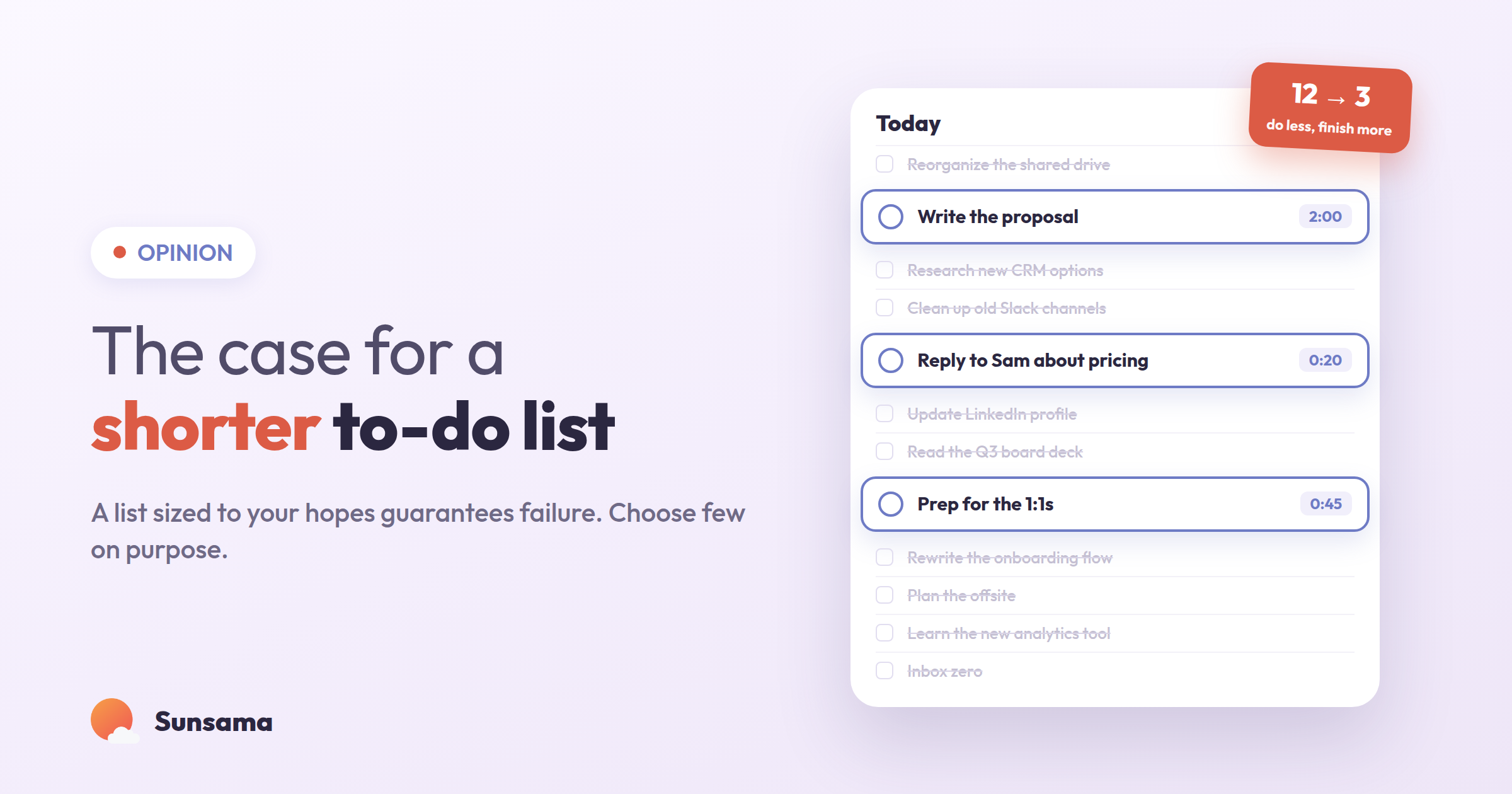
Look at your to-do list right now. Really look at it. If you’re like most people, it’s long — twenty, thirty, fifty items, some of them weeks old, a few you’ve copied forward so many times they’ve become furniture. You feel vaguely guilty every time you open it, and vaguely virtuous every time you add something new. And here’s the part worth sitting with: on a normal day, you will finish maybe four or five of those things. You knew that already. You wrote down thirty anyway.
We’ve been sold a quiet lie about to-do lists — that a longer one means you’re on top of more, that capturing everything is the same as controlling it, that the goal is a system comprehensive enough to hold your entire life. So we optimize the list. We tag it, color it, nest it, sync it across devices. And it keeps growing, because a list with no ceiling always grows. The dirty secret of productivity culture is that most of us don’t have a doing problem. We have a deciding problem, and a long list is how we avoid deciding.
This is an argument for the opposite move. Not a better-organized long list — a deliberately short one. Fewer things, chosen on purpose, finished on time. It feels, at first, like giving up. It is actually the only version that works.
Why the long list quietly fails you
A to-do list is supposed to reduce anxiety by getting things out of your head. A fifty-item list does the reverse. Every time you open it, your brain does a small triage it can’t win: everything is visible, nothing is prioritized, and the sheer volume signals you are behind before you’ve done anything at all. You start the day already losing.
The long list also lies about time. Writing a task down takes three seconds; doing it takes two hours. A list makes no distinction — “reply to Sam” and “rewrite the onboarding flow” sit there as equal-looking bullets, so the list always looks achievable and never is. You end the day having done real work and still feeling like you failed, because you measured yourself against a number that was never physically possible. Do that enough times and you stop trusting your own plans, which is its own kind of damage.
And a long list hides the decision you’re actually avoiding. When everything is on the list, nothing has been chosen. The list becomes a place to put intentions rather than act on them — a holding pen for your ambitions where they can feel acknowledged without ever being committed to. Adding a task feels like progress. It isn’t. It’s the most comfortable form of procrastination we’ve invented, because it looks exactly like diligence.
Try it in Sunsama: Tomorrow, instead of working from your master list, pull only the handful of things you’ll genuinely do today into your day — and give each one a time estimate. Then add the estimates up. When the total bumps against the hours you actually have, you’ve found your real list. The number does the deciding you’ve been avoiding, and it’s almost always smaller than you hoped.
Capacity is the thing nobody plans around
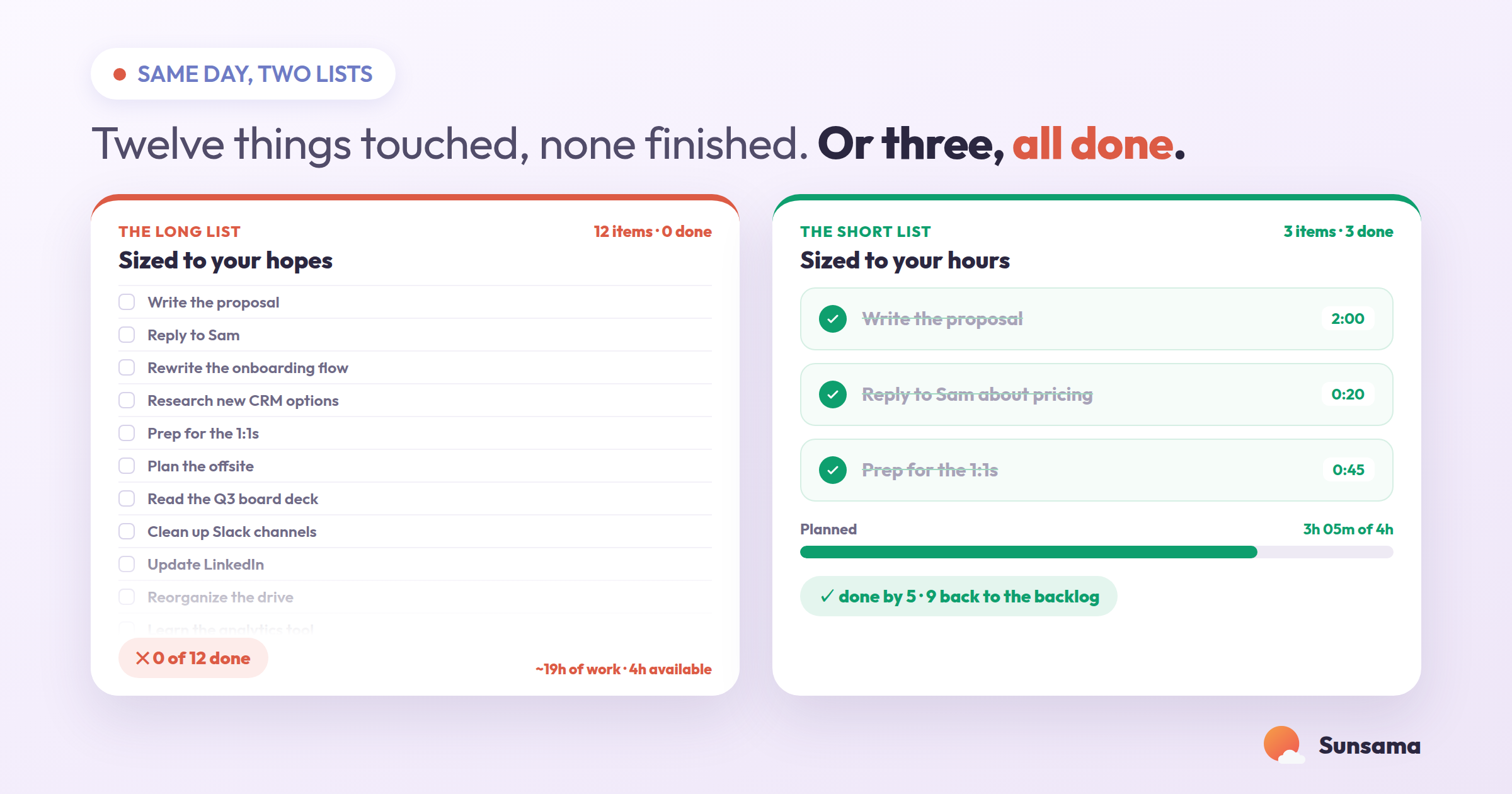
Here is the fact every long list ignores: a day holds a fixed amount of work, and it’s less than you think. Between meetings, email, the interruptions, the lunch you’ll actually take, and the fact that your brain isn’t a machine, a typical knowledge worker has maybe three to five hours of genuine task time in a day. Not eight. The other hours are real and necessary — they’re just not available for your list.
Once you accept that number, the whole game changes. The question stops being “what do I need to get done?” (answer: everything, always, forever) and becomes “what fits, and what’s worth putting there?” That’s a question you can actually answer. It’s the difference between planning against your hopes and planning against your hours — and only one of those produces a day you can finish. Sunsama’s official daily planning guide is built entirely around this move: planning a day you can actually complete, not one that mocks you by 2pm.
The short list isn’t about ambition deflation. It’s about honesty. You will do the same amount of real work either way — the short list just stops you from lying about the rest.
How to shrink the list without losing anything
The fear, of course, is that if you stop tracking everything, things will fall through the cracks. They won’t — but the method matters. Doing less on purpose has a shape to it.
Keep the big list, but stop working from it. You still need somewhere to capture everything so your brain can let go — a backlog, a someday pile, a holding tank. The shift is that this list is a library, not a plan. You visit it to choose; you don’t live in it. Capturing and committing become two different acts, which is exactly as it should be.
Choose today’s few deliberately. Each morning, pull a small number of things — for most people three to five real tasks — from the library into today. Choose them the way you’d pack a bag for a trip: with a hard limit that forces real decisions. If everything can come, you haven’t packed, you’ve just relocated the pile. Setting an actual daily intention for the day — the one thing that would make it a good day — makes this choice easier, because you’re selecting toward something instead of just skimming the top of the pile.
Let a simple filter break the ties. When you can’t decide what makes the cut, don’t agonize — run the contenders through a quick priority matrix. Important and urgent: today. Important, not urgent: protect a slot for it this week before it becomes a crisis. Urgent but not important: the stuff that feels pressing and changes nothing — be suspicious of it. Neither: why is it still on the list? The point isn’t the quadrants; it’s that a filter decides faster and more honestly than your guilt does.
Try it in Sunsama: Move unfinished tasks forward to a specific future day instead of letting them pile up on today. In Sunsama, anything you don’t get to doesn’t just roll over in a guilty heap — you consciously reschedule it to a day you’ll actually have room. Items that get rescheduled four or five times start to reveal themselves: they were never really going to happen, and admitting that is a feature, not a failure.
Review weekly, so the daily lists can stay light. The short daily list only works if something larger holds the thread. That’s what a weekly review is for: once a week you look at the whole library, prune what’s gone stale, and decide what actually deserves a day in the week ahead. Do that, and you can trust the small daily list completely, because you know the big picture is handled somewhere reliable. The weekly review is the safety net that makes doing less each day feel calm instead of reckless.
Pro Tip: Set a hard cap on today’s list — a literal number, like five — and treat it as full when it’s full. If something genuinely urgent comes up, you don’t get to just add it; you have to take something else off first. This one rule does more than any app feature: it turns every new “I should also...” into a real trade-off instead of a free addition, and trade-offs are where honest prioritizing actually happens.
Finishing is a feeling, and you’ve been starving yourself of it
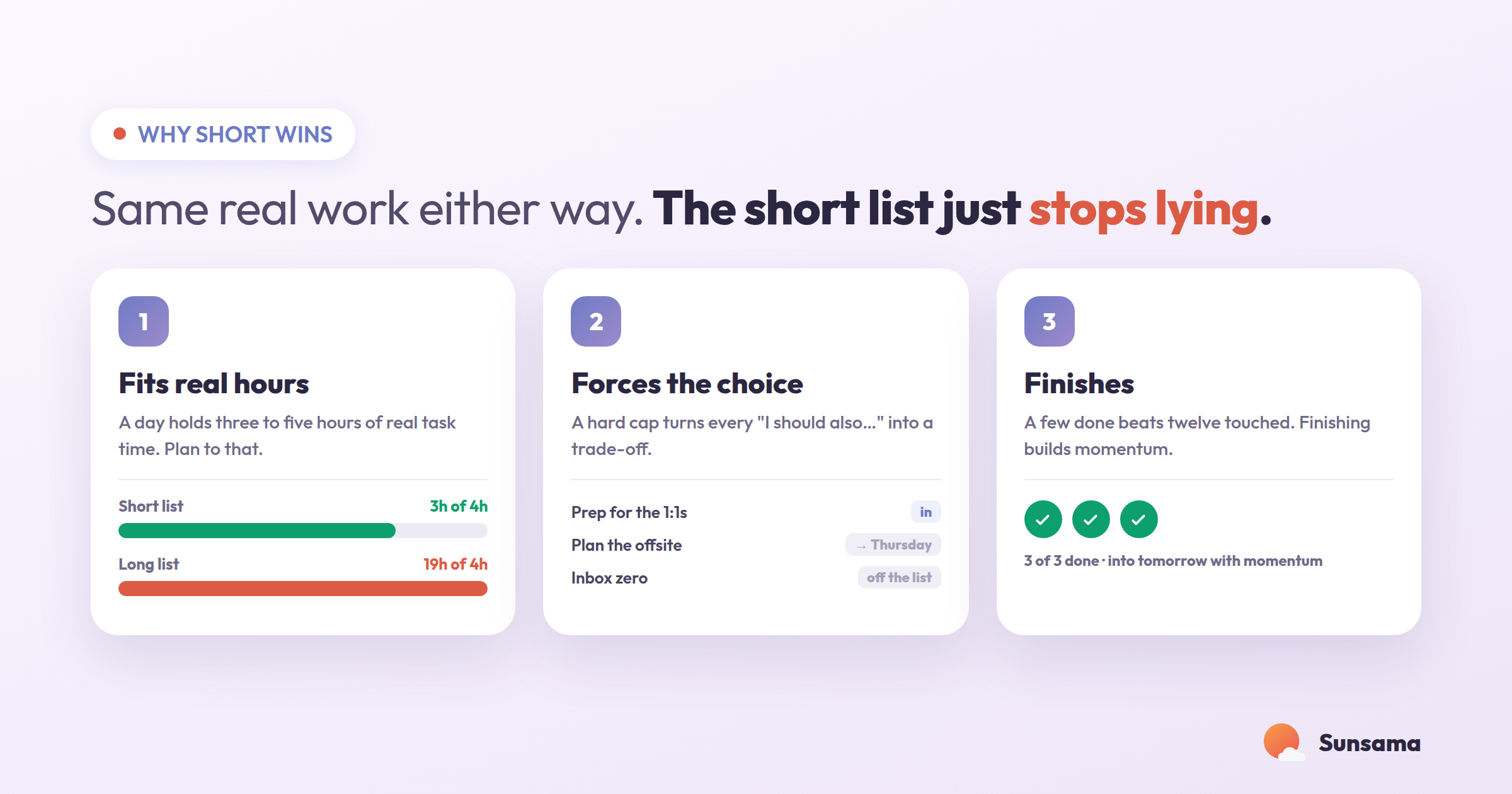
There’s a reason the short list does more than just make your day realistic — it changes how the work feels. Finishing things is motivating in a way that starting things is not. A day where you completed four chosen tasks ends with a small, real sense of done. A day where you touched twelve things and completed none ends with a low background hum of failure, no matter how hard you worked. Same effort. Completely different relationship with your own work.
Over weeks, that difference compounds. The person working a short, finished list each day builds momentum and trust in their own plans. The person grinding against an infinite list builds resentment and burnout, and eventually stops planning altogether because planning only ever confirms they’re behind. Doing less isn’t the lazy option. It’s the sustainable one — the only one that’s still standing in a year.
So give yourself permission to cross most of it off before you even start. Not because those things don’t matter, but because a list sized to your fears was never going to get you anything but tired. Choose the few. Finish them. Let tomorrow be its own small, completable thing. That’s not doing less in the sense that matters. That’s finally doing the right amount — and actually getting to the bottom of it.
If you want a planning tool built around the short, finishable day rather than the endless list, that’s the whole idea behind Sunsama — it pulls your tasks and calendar into one place and gently holds you to what actually fits. There’s a 14-day free trial. But the mindset is free, and you can start tomorrow morning with nothing but a shorter list.