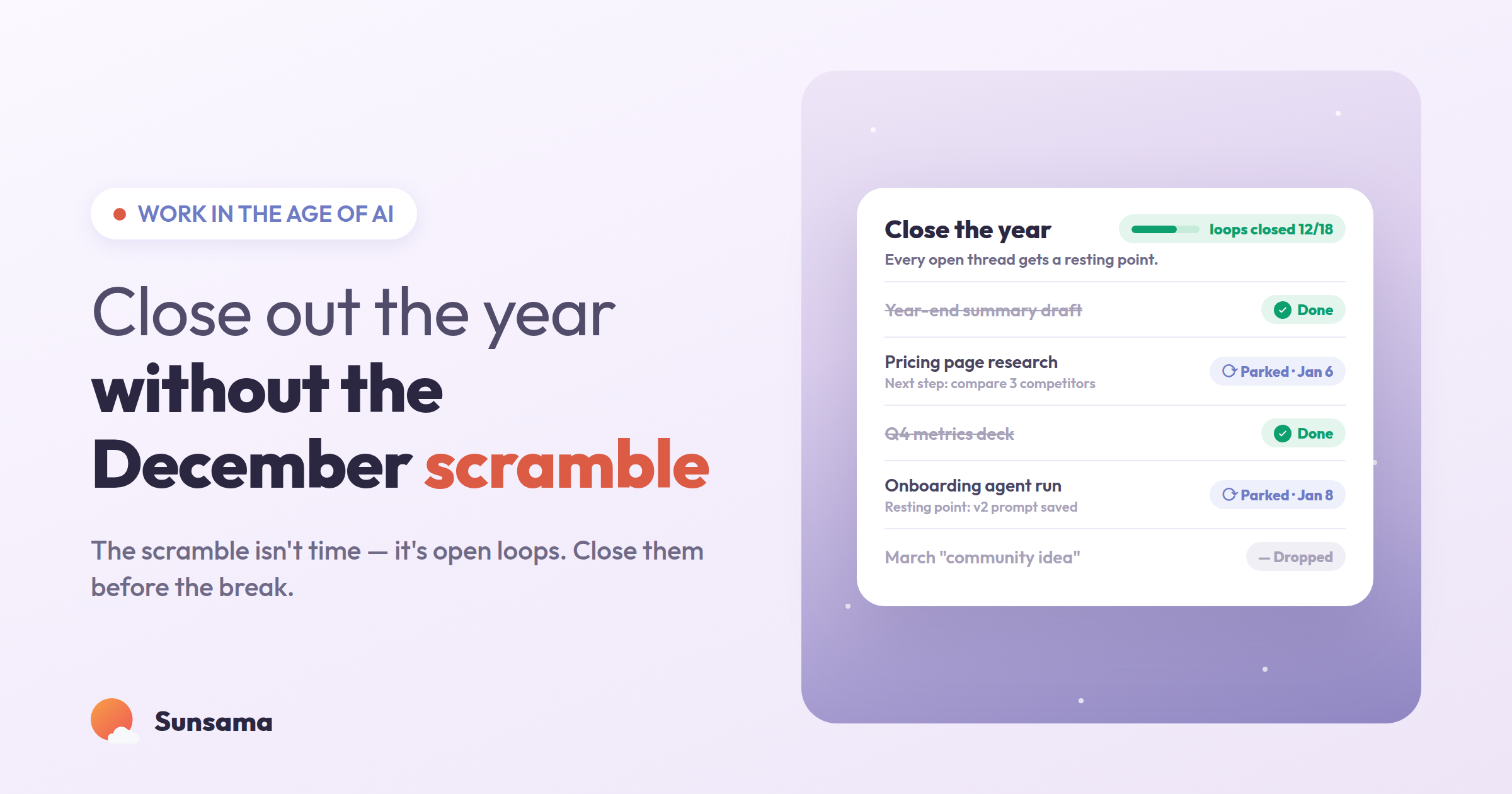
Sometime in the next few weeks, you’ll feel it start. The quiet pressure of a year with loose ends. A dozen projects that are “almost there.” Threads you’ve been meaning to get back to since October. A list of things you told yourself you’d finish before the break, and a calendar that’s filling up with everything except the time to do it.
Here’s the part nobody says out loud: this year, you probably started more than you ever have. A draft, a research pass, a prototype — with AI, each of those is one prompt away, so you spun up more of everything. More chats, more agents, more half-built things moving an inch at a time. The scramble you feel in December isn’t really about time running out. It’s about open loops — all the work you started and haven’t closed, each one still quietly pulling at your attention.
So the goal for the end of the year isn’t to cram. It’s to close loops. To go into the break with fewer things open in your head, a clear record of what you actually got done, and a short, honest plan for what’s worth carrying into January. Here’s how to do that without turning the last three weeks into a sprint.
Why the end of the year feels heavier now
A year used to end on time. The work came to you from people and meetings, you did it, and when December arrived you could more or less see the finish line. The hard part was finding the hours.
That’s not the shape of work anymore. When starting is free, you start everything — and every thread you open stays open until it’s actually done. Psychology has known this for a long time: an unfinished task keeps tugging at your attention until you either finish it or make a concrete plan for it. Multiply that by a year of AI-assisted starts and you get the real year-end feeling — not “I’m out of time,” but ”my head is in fifteen places and none of them are finished.”
That’s why the usual year-end advice (“just power through,” “block a big day and grind”) doesn’t land. You can’t power through forty open loops. But you can close them, a few at a time, and that’s a completely different, much calmer kind of December.
A five-step close-out that actually fits
You don’t need a retreat or a frozen calendar. You need a repeatable pass you can do over a couple of weeks, in the gaps you already have.
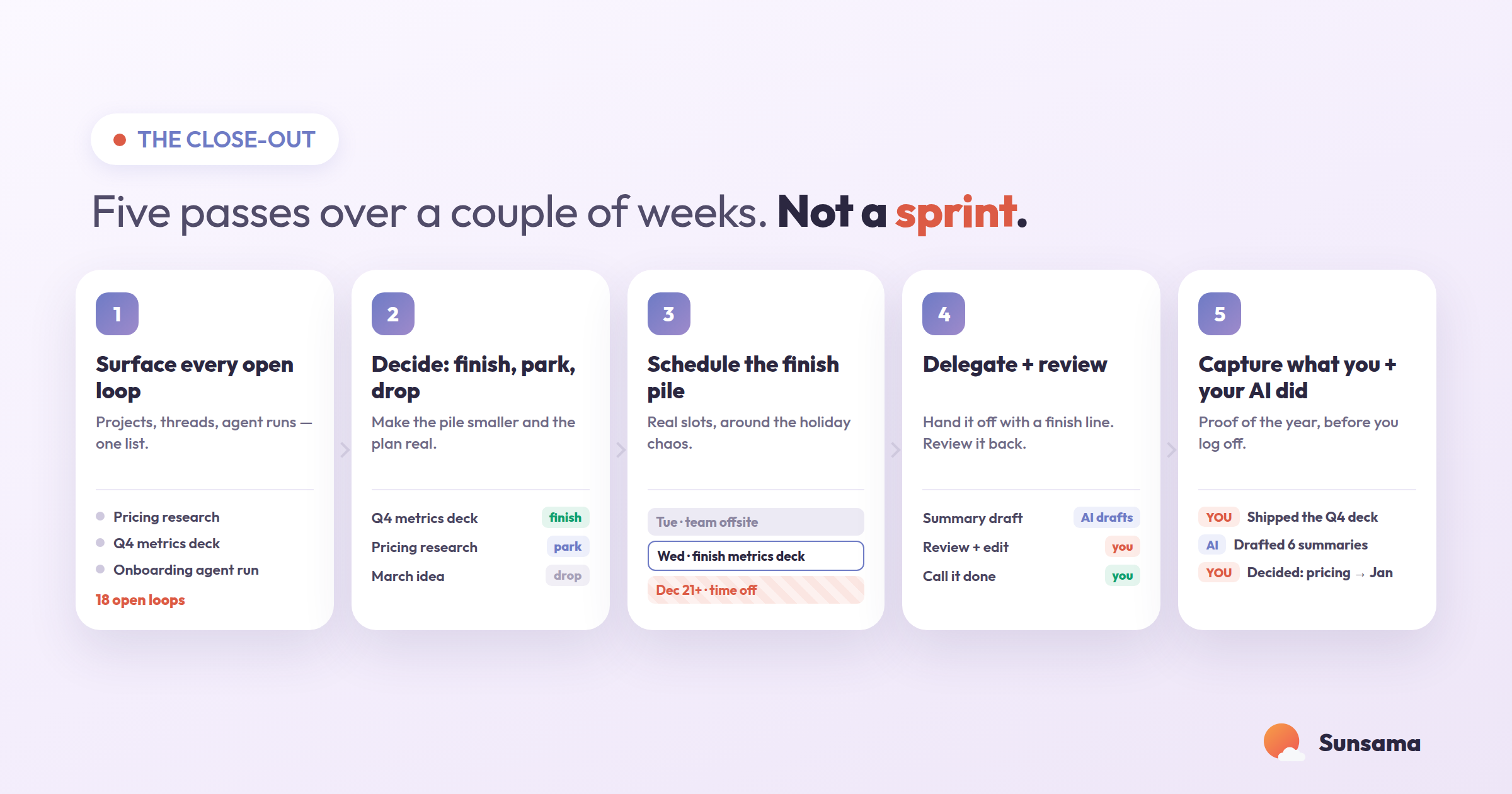
1. Get every open loop out of your head and into one place
You can’t triage what you can’t see. Before you decide anything, do a sweep of everything that’s still open — the projects, the threads, the “I should really…” items, the agent runs you half-abandoned, the chats with good work buried three versions deep. Pull them into one list. This is the oldest trick in planning for a reason: a thorough brain dump is what finally lets your mind stop holding all of it at once.
2. Decide what actually gets finished — and let the rest go, on purpose
Not everything open deserves to close this year. Go down the list and sort each item into one of three honest buckets: finish it (it’s close and it matters), park it (it’s real but it’s a January problem — give it a resting point so it stops nagging), or drop it (it was a good idea in March and it isn’t anymore). The point isn’t to do more. It’s to make the pile smaller and the remaining plan real. If deciding what’s worth it is the part you freeze on, what should I work on today? is the same muscle applied to a single day.
Pro Tip: For anything you park, write one line — where it stands and the next concrete step — before you move on. That single sentence is what turns an open loop into a closed one in your head, even though the work itself isn’t done. The thread stays open; you don’t have to keep carrying it.
3. Put the “finish” pile on real days
A list of things to finish is a wish until it meets your actual calendar. Take the items you committed to in step 2 and give each one a real slot in the weeks you have left — around the holiday chaos, not pretending it doesn’t exist. Costing the work against the hours you truly have is the difference between a plan and a hope; it’s the whole idea behind time blocking, and it’s especially unforgiving in December, when half your week is already spoken for.
Try it in Sunsama: Each morning, let Autoplan draft the day around your meetings, so your finish-list lands in the gaps that actually exist — then adjust and approve it.
Watch the Pro Tip: Using projections and calendar view to plan the week ahead (4:37) — switch to the calendar view to see next week’s task projections, spot open time, and drag tasks onto the days you want.
4. Use AI to clear the finishable work — then review and own it
This is where the end of the year can actually be lighter than it used to be. A lot of what’s on your “finish” pile is exactly the kind of work AI is good at starting: the draft of the year-end summary, the first pass at cleaning up the doc, the research you never circled back to. Hand those out. The move that keeps it from becoming more open loops is simple: send each one off with a finish line attached and a plan to review it, so the work comes back to you instead of quietly joining the pile. AI does the middle; you decide what’s worth doing and you call it done.
5. Capture what you and your AI actually got done
The last loop to close is the biggest one: proof. Work disappears the moment it’s finished, and this year AI has blurred who did what, which is exactly why December can feel like a blur even after a genuinely productive year. So before you log off, write down what got done — by you and by your AI — and what you decided along the way. It’s the raw material for your year-end review, your self-review, the update your manager wants, and a far saner starting point for January than a blank page. A proper weekly review is the same practice at a smaller scale; the year-end version is just the zoomed-out one.
Watch the Pro Tip: Use recurring task notes for accurate, quick, personalized reflections (3:25) — journal in a recurring task’s notes as your day goes, then paste them into your daily shutdown for a faster, more accurate record of what got done.
The reframe: finish the year, don’t just end it
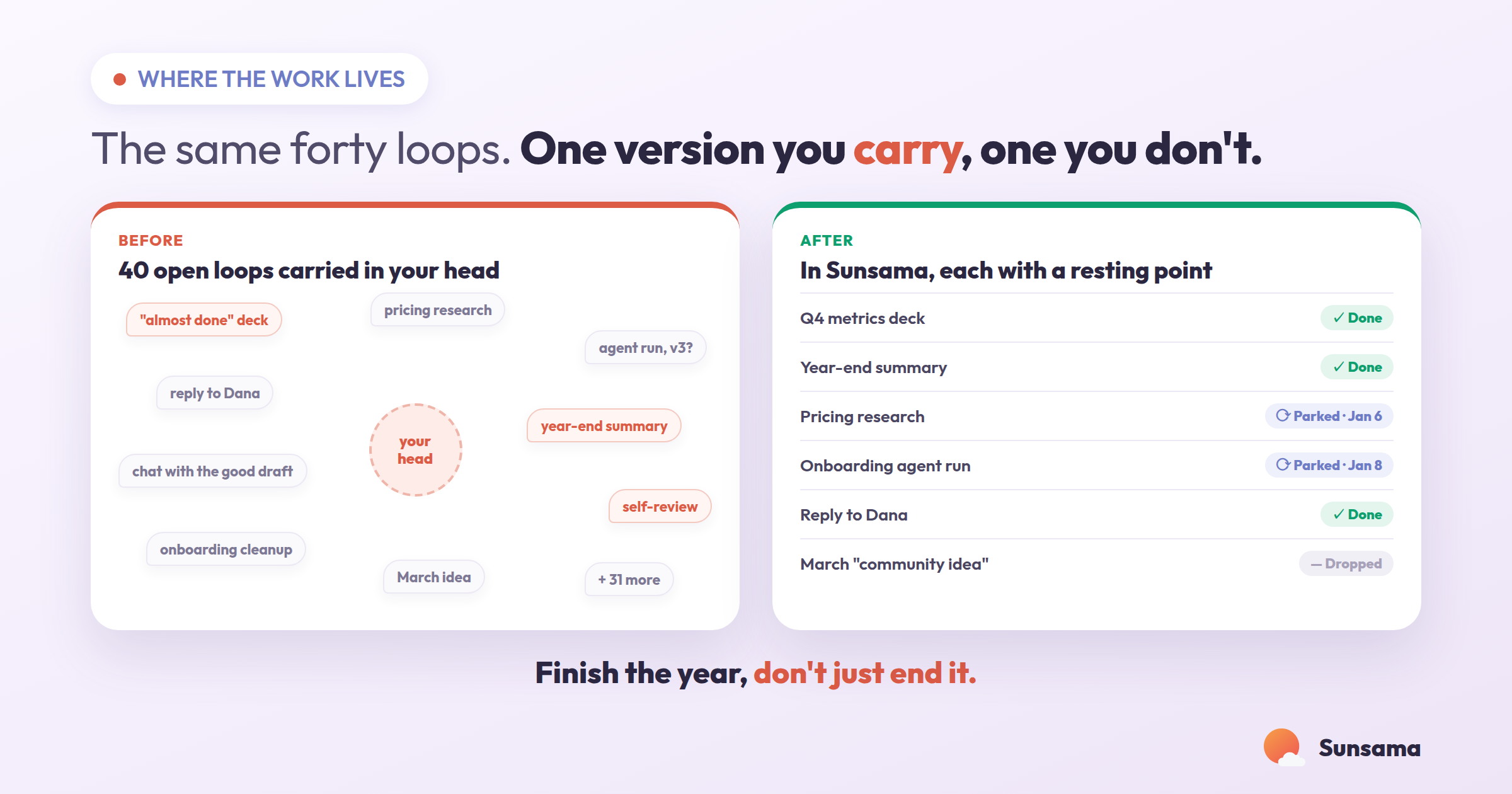
There’s a version of late December that’s all grind — a frantic attempt to touch everything one more time before the lights go out. And there’s another version where you close the laptop on the 20th with most of the loops closed, a clear record of the year, and a short list of what’s genuinely worth carrying forward.
The difference isn’t how many hours you find. It’s whether the work lives in one place you can come back to, or in your head. AI helped you start more this year than ever. The thing that makes it a good year instead of an exhausting one is finishing — and knowing you did. That’s the whole job of the last few weeks: not to do more, but to close what’s open, so you can actually step away.
Get started this week
You don’t have to wait for the holidays to begin. This week, do just step one: get every open loop out of your head and into a single list. Don’t triage yet — just see it all in one place. Most of the December dread comes from carrying forty open things at once without ever looking at them straight on. Once they’re on one page, you’ll find that a surprising number are ready to be dropped, a few are an hour from done, and the rest just needed a resting point. That’s a close-out, not a scramble — and it’s how you start January leading your year instead of catching up on it.