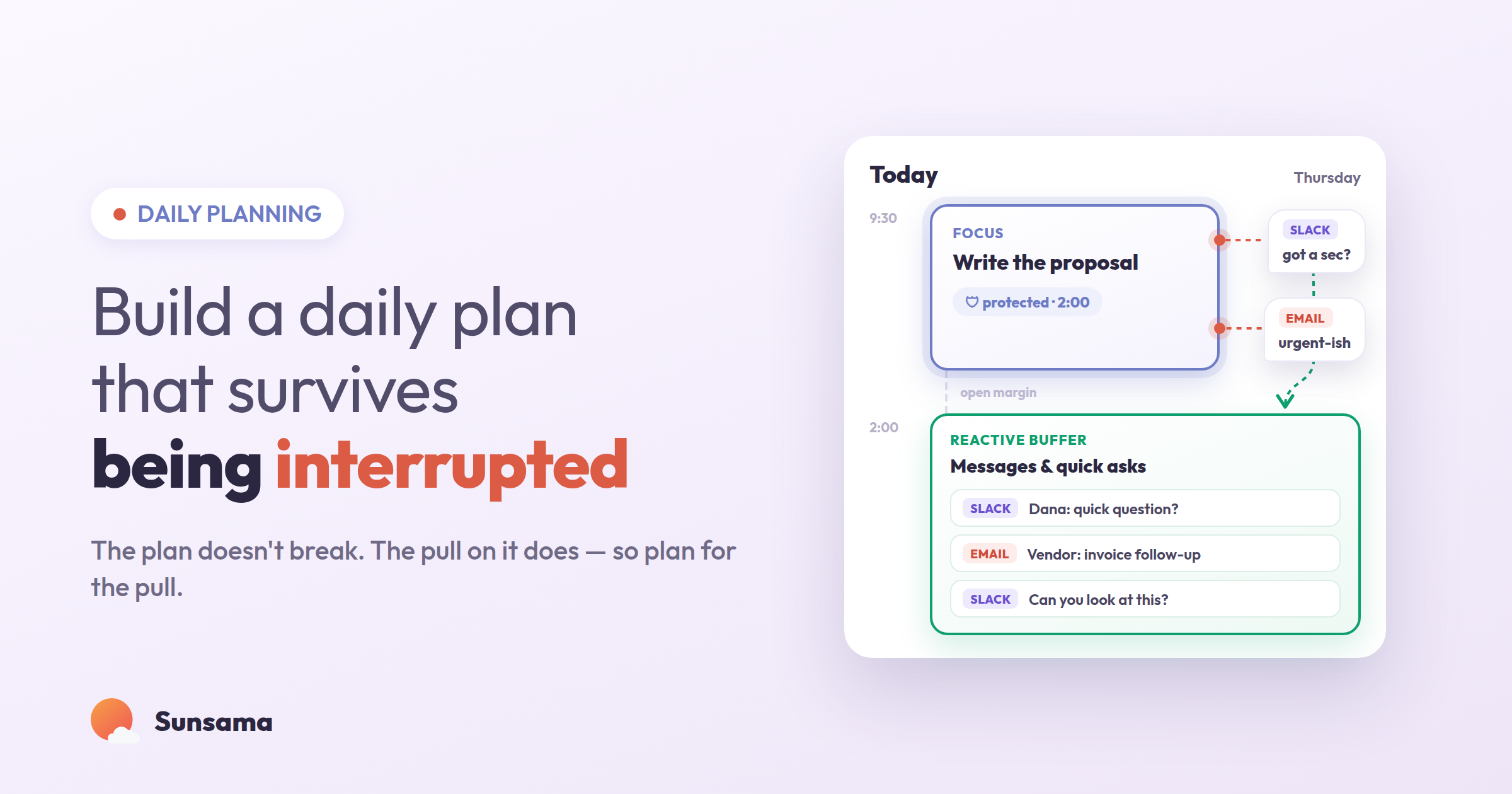
You make a good plan. You know you do. You sit down in the morning, you pick the few things that matter, maybe you even block time for them — and then at 9:40 a Slack message arrives, and a “quick question” turns into forty minutes, and someone drops a thing on you that’s suddenly urgent, and by lunch the careful plan you made is a museum piece. You look at it with a kind of grief. Then you decide, quietly, that planning doesn’t work for someone with a job like yours.
Here’s the reframe worth sitting with: a plan that only works on an uninterrupted day isn’t a plan, it’s a fantasy. Most people build the fantasy, watch reality break it by 10 a.m., and conclude they’re bad at planning. They’re not. They’re planning for a day that doesn’t exist — a clean, quiet, self-directed day — when their actual days are full of other people’s requests arriving at unpredictable times.
The fix isn’t more discipline or a stricter morning. It’s building the interruptions into the plan from the start, so that getting pulled away is something your day expects and absorbs, not something that detonates it. A good plan doesn’t resist interruption. It has room for it.
Why the airtight plan always loses
The instinct, when days keep getting wrecked, is to plan harder — to block every hour, account for every task, leave no slack. This feels responsible. It’s the exact opposite of what works.
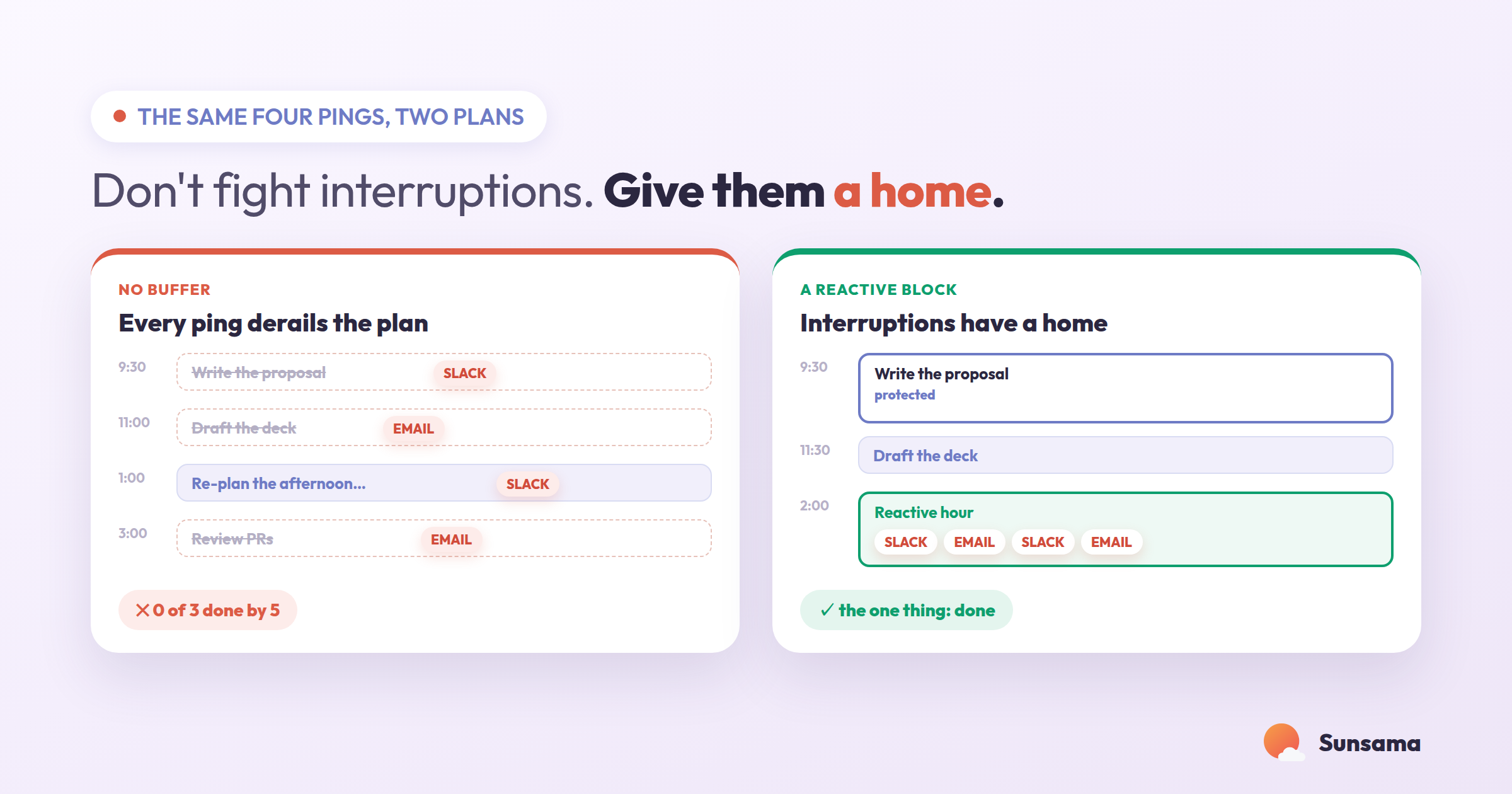
An airtight plan is brittle by design. If every minute is assigned, then the first unplanned thing that lands has nowhere to go, and it has to displace something. Now you’re not just handling the interruption — you’re re-planning the entire afternoon in your head while the interruption is still talking. One surprise and the whole structure has to be rebuilt, which is so exhausting that most people just abandon the plan entirely and spend the rest of the day reacting. The tighter you pack the day, the more completely a single interruption breaks it.
The counterintuitive move is to plan less of the day on purpose. A plan with deliberate empty space isn’t a lazy plan — it’s a plan that can take a hit and keep standing. The empty space is where the interruptions live. You’re not failing to use those hours; you’re reserving them for the reality you already know is coming.
The method: a plan built to absorb the day
Here’s a six-step way to build a daily plan that bends instead of breaks. It takes about five minutes each morning and one honest check at midday.
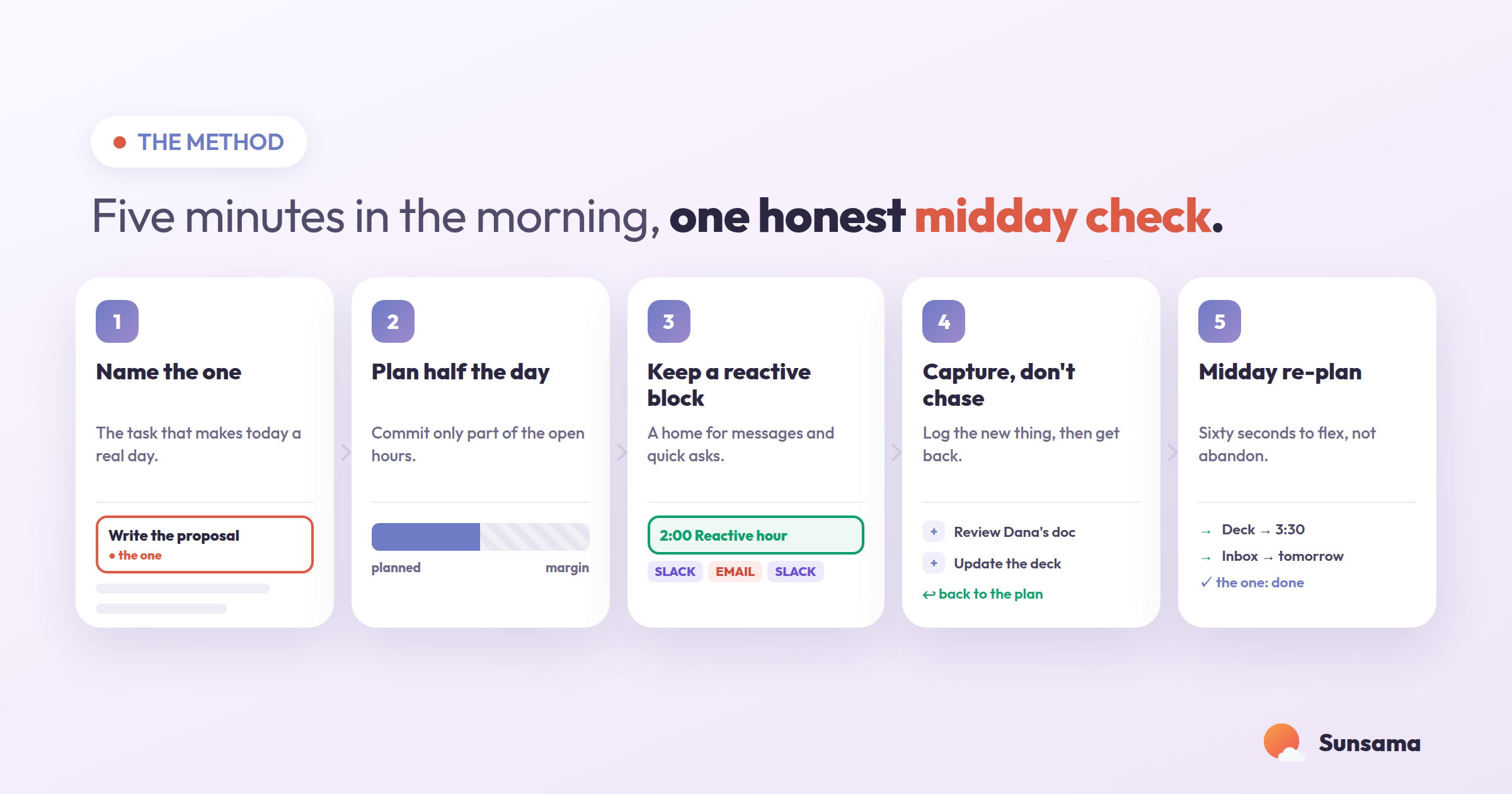
1. Name the one thing that has to happen. Before anything else, decide the single task that, if it’s the only thing you finish, makes today a real day. Not five things — one. On an interrupted day, the goal isn’t to do everything; it’s to protect the one that matters from the forty that don’t. Everything else in the plan is negotiable. This one isn’t. (If you’ve never done this, setting a daily intention is the muscle underneath it.)
2. Plan only about half the day. Add up your real meetings, then commit tasks to only a portion of the hours that remain — not all of them. If you have four open hours, plan two to three of real work. The rest is margin: unassigned on purpose. This feels wrong the first few times, like you’re slacking. You’re not. You’re leaving the room that the day’s interruptions will need, so that when they arrive they land in empty space instead of crushing a commitment.
3. Give reactive work its own block. Most interruptions aren’t truly urgent — they just feel urgent because they arrive live. So give them a home. Put one or two deliberate “reactive” blocks on the day — thirty to sixty minutes where handling messages, questions, and small requests is the job. When a non-emergency pull arrives outside that block, it has somewhere to go: “I’ll get to that at 2.” Most things can wait two hours. The ones that genuinely can’t are rare, and now they stand out clearly instead of hiding in a constant blur.
Try it in Sunsama: Block one “reactive hour” on your calendar every afternoon and treat it as a real task with a time estimate. When a non-urgent request lands mid-morning, drop it into that block instead of doing it now. You’ll protect your focused hours and still clear the small stuff — in a container, on your terms.
4. Capture the interruption; don’t chase it. When something does pull you away, the damage usually isn’t the interruption itself — it’s the three other things it reminds you of that you then chase down a rabbit hole. Keep the response small: capture the new thing into your list, handle the actual ask if it’s quick, and get back. The capturing is what lets you return to your plan instead of drifting from it. Your plan is the thing you come back to; it only works if leaving it feels temporary.
5. Re-plan once, at midday — don’t abandon. Here’s the step almost everyone skips. Around lunch, take sixty seconds and look honestly at the morning: what got done, what didn’t, what the afternoon actually holds now. Then adjust. This is the difference between a plan that “fell apart” and a plan that flexed. A plan isn’t a promise you made at 9 a.m. that you’ve now broken — it’s a living thing you get to revise when the day gives you new information. One honest reset beats white-knuckling a morning plan that no longer matches reality.
Try it in Sunsama: At midday, re-open today and move anything you didn’t get to onto the hours you have left — or roll it to tomorrow on purpose. Thirty seconds of deliberate rescheduling turns “I’m so behind” into “here’s what’s actually left,” which is a completely different feeling to carry into the afternoon.
6. Close the day honestly, not perfectly. At the end, don’t measure the day against the fantasy version where nothing interrupted you. Measure it against the one thing you named in step one. Did it happen? Then it was a good day, however chaotic the middle got. Roll the unfinished work forward with a real decision — a specific day, or off the list — so nothing silently accumulates. (If you want a repeatable version of this, a weekly review is where the rolled-over work gets a sober second look.)
The quiet skill underneath all of this
Every step above is really one skill wearing different clothes: deciding, in advance, that you will not treat every incoming request as an emergency. That’s not rudeness and it’s not rigidity. It’s the thing that lets you be genuinely responsive to the requests that matter, because you’re not frantically reacting to the ones that don’t.
Some of this is tooling — a single place where your plan, your calendar, and your reactive block live together so you can see the whole day at once, which beats juggling it in your head. We walk through building that kind of day in the official daily planning guide, and the hour-by-hour mechanics in our time blocking tips. But a lot of it is permission — permission to protect a block, to say “I’ll get to that at 2,” to leave half the day unplanned on purpose. Some of that permission has to come from you, and some of it is a boundary you set out loud, which is its own learnable skill; we wrote about saying no at work without burning bridges for exactly that.
Try it in Sunsama: For one week, plan only half of each day and keep a reactive block in the afternoon. At the end of the week, count how many days your one key task actually got done. That number — not whether the plan survived untouched — is the real measure. Most people find it climbs, precisely because they stopped trying to protect an airtight plan and started protecting the one thing that mattered.
Pro Tip: When a genuine emergency blows through everything — and occasionally one will — don’t try to salvage the original plan. Declare the day a different day. Handle the emergency, then make a brand-new, tiny plan for whatever hours are left: one or two things, honestly estimated. Trying to force a wrecked morning’s plan onto a transformed afternoon is how a hard day becomes a demoralizing one. A fresh, small plan for the time you actually have left is always available, and it’s always kinder than the guilt of a plan you “failed.”
An interrupted day was never evidence that you can’t plan. It’s just evidence that you were planning for the wrong day. Build for the one you actually have — the one with other people in it — and the plan stops being something that shatters by 10 a.m. and starts being something that quietly holds, all the way to the end.