You know the pattern. Monday you feel on top of it. Tuesday holds. Then Wednesday afternoon something slips, Thursday you’re reacting instead of deciding, and by Friday the week’s real priorities — the ones that actually mattered — never got their turn. The week didn’t fail on Friday. It failed on Monday morning, when you started doing without first deciding what the week was for.
Most of us plan days and hope the week takes care of itself. But a day is too small a unit to protect what matters. The important work — the project that moves the needle, the thinking only you can do — rarely fits in a single day’s margins. It needs to be claimed at the level of the week, or it gets crowded out one reasonable daily decision at a time.
Planning your week is how you claim it. Not an elaborate ritual — a focused thirty minutes that decides, in advance, what these five days are actually for. Here’s a calm, practical way to do it, and how to keep it alive past Wednesday.
Why a week is the right unit to plan
A day is where you execute. A week is where you decide. Confuse the two and you get the familiar trap: every day feels busy and productive, but the week adds up to nothing that matters, because no single day ever had room for the big thing.
The week is the smallest unit large enough to hold real priorities. Within a week you can protect a few hours for deep work, absorb a bad day without losing the plot, and see whether you’re actually moving toward something or just staying afloat. Plan only in days and you’re always negotiating with today’s noise. Plan the week first and each day becomes a smaller, easier question: not “what should I do?” but “what does my week need from today?”
That shift — from planning in reaction to planning in advance — is the whole game.
The three questions a weekly plan answers
A good weekly plan isn’t a list of everything. It’s the answer to three questions, in order.
What are the two or three things that, if they happen, make this a good week? Not ten. Two or three. These are your week’s spine — the outcomes worth protecting time for. Everything else is secondary by definition, and naming them is what lets you say no later without guilt.
When will each of them actually happen? A priority without a time is a wish. Look at the week’s real shape — the meetings already booked, the days that are lighter — and give each big thing a home on a specific day, in a specific block. If it can’t find a slot, that’s not a scheduling problem; it’s the week telling you the truth about your capacity.
What can I let go of? Every honest weekly plan has a “not this week” pile. The tasks that are real but not now. Naming them is a feature, not a failure — it’s the difference between a week you chose and a week that happened to you.
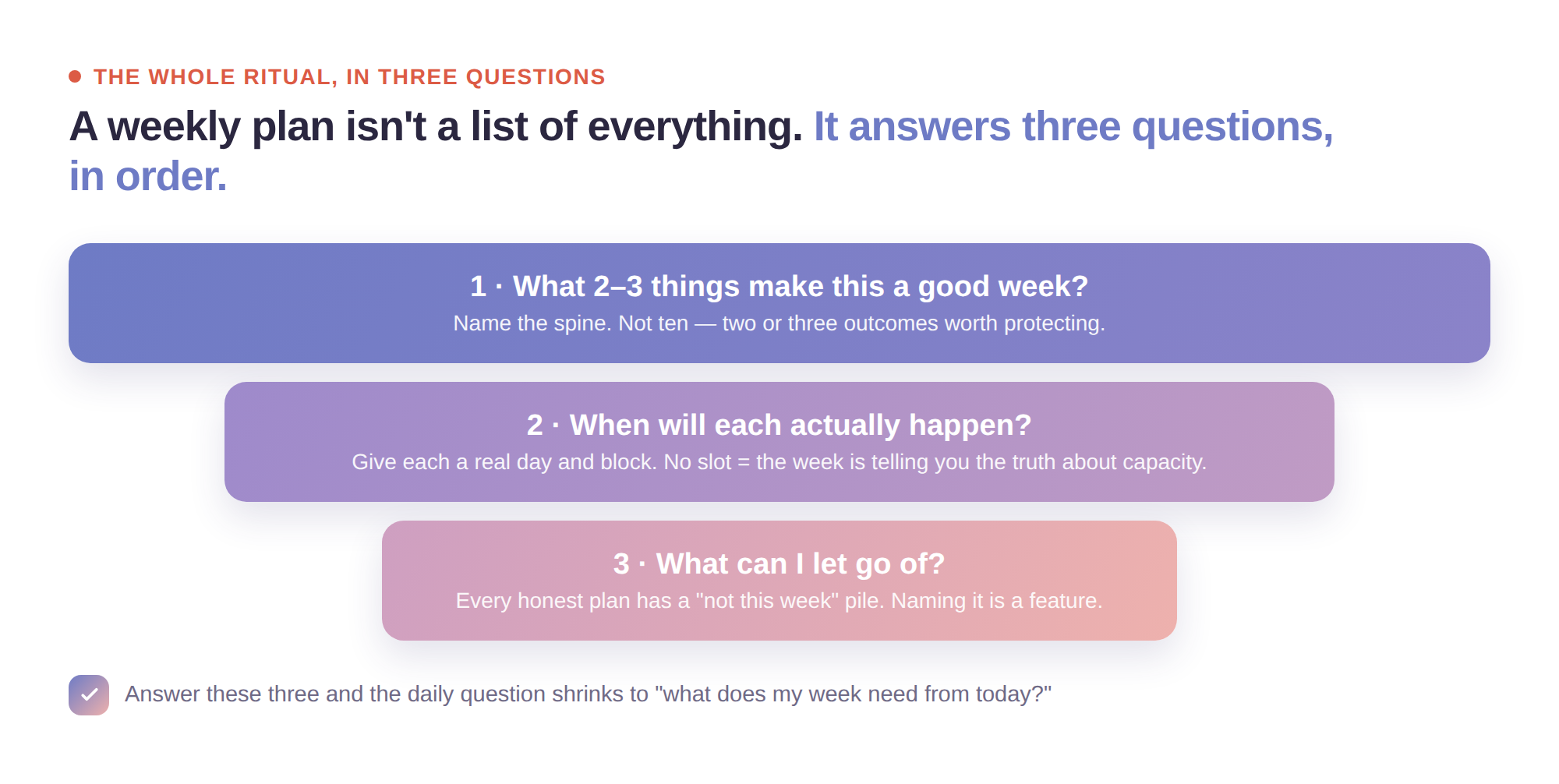
A thirty-minute weekly planning ritual
Do this once a week — Sunday evening or Monday morning, whichever you’ll actually keep. Thirty minutes, same time, protected like a meeting.
1. Look back before you look forward
Start with last week. What got done, what didn’t, what kept slipping? This isn’t self-judgment — it’s data, and it’s exactly what a good weekly review is for. The tasks you moved forward three times are trying to tell you something (they’re too big, wrongly timed, or secretly not important). A quick look back makes the plan forward realistic instead of aspirational.
Try it in Sunsama: Use your weekly view to see what carried over, so you plan the new week from what actually happened, not from an optimistic blank slate.
2. Name the two or three that matter
Before touching tasks, decide the week’s spine: the two or three outcomes that define a good week. Write them where you’ll see them all week. This is the highest-leverage minute of the whole ritual — everything downstream is easier once you’ve decided what’s actually worth protecting.
3. Give the big things a day and a time
Now open the week’s calendar and place each priority on a real day, in a real block, before the week fills with everything else. Deep work goes on your best hours. This is you setting a boundary in advance — claiming the time while it’s still yours to claim, so a “quick sync” can’t quietly eat the block you needed for the thing that mattered.
Try it in Sunsama: Drag your week’s priorities straight onto the calendar as timeboxed blocks, so they hold real space instead of floating on a list.
4. Rough in the rest — lightly
Sketch the supporting tasks across the week, but don’t over-plan days that are still four days away. You don’t know what Thursday will actually look like yet. Assign the big rocks to specific days; leave the small stuff loosely grouped. A weekly plan that’s scheduled to the minute on Monday is a plan that shatters on Tuesday.
5. Leave one day with slack
Something will go wrong this week — it always does. So don’t plan five packed days. Leave one day (or several half-days) with real breathing room to absorb the overflow, the fire, the thing that runs long. The buffer isn’t wasted; it’s what lets the plan survive the week instead of being abandoned by Wednesday.
Pro Tip: Protect a recurring ninety-minute block early in the week for your single most important thing, and treat it as immovable. If the week blows up, that one block having survived is often the difference between a week that felt lost and one that counts — because the thing that mattered got done before the chaos arrived.
How to keep it alive past Wednesday
A weekly plan isn’t a contract; it’s a starting position. The reason most plans die midweek is that people treat the first deviation as failure and abandon the whole thing. Don’t.
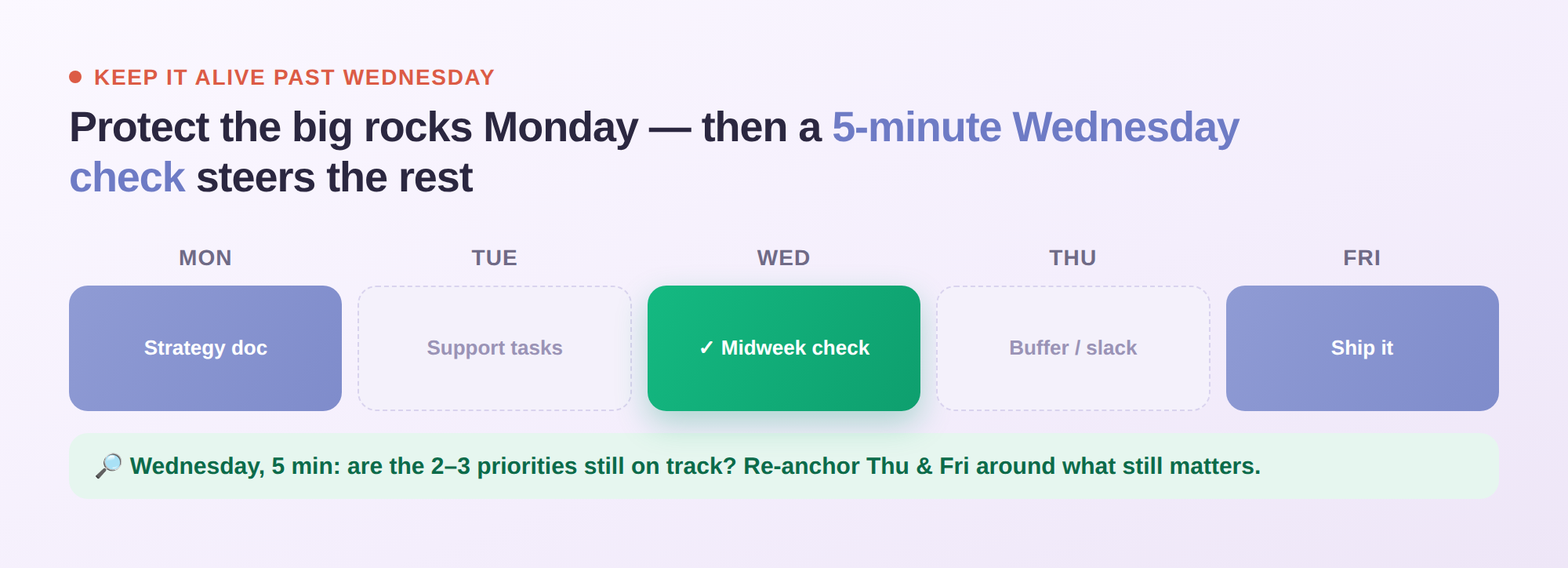
Instead, build in a small midweek check — five minutes on Wednesday. Look at your two or three priorities: are they still on track? What’s changed? Re-anchor the rest of the week around what still matters. This isn’t re-planning from scratch; it’s a light steering correction, the weekly-scale version of setting a daily intention. Five minutes on Wednesday is what keeps Thursday and Friday from becoming pure reaction.
The people who consistently end weeks feeling in control aren’t the ones whose weeks go according to plan. Nobody’s does. They’re the ones who decided in advance what the week was for, protected time for it, and adjusted from that decision instead of starting over in panic every time the week moved.
Start with this week
You don’t need a system to begin. This Sunday or Monday, take thirty minutes and answer the three questions: what two or three things make this a good week, when will each happen, and what are you letting go of. Put the big things on the calendar before the week fills up. Then check in on Wednesday.
That’s it. A day is where the work happens — but the week is where you decide whether the work was worth doing. Plan the week, and the days get a lot easier to run.