Some days you don’t have a schedule so much as a wall. Nine to five, back to back, other people’s agendas stacked end to end. You’re busy every minute and yet you end the day having done nothing you’d actually call your work — just talked, listened, nodded, and watched your real to-do list sit untouched.
You can’t always cut the meetings. That’s the honest starting point. Advice about reducing meetings at the company level is fine in theory, but on the day itself, the meetings are already on the calendar and most of them you can’t move. The question that actually helps isn’t “how do I have fewer meetings” — it’s “how do I get something real out of a day that’s already full of them.”
There’s more room in a meeting-heavy day than it feels like. Not by working harder in the gaps, but by treating the meetings themselves — and the small spaces around them — deliberately instead of just enduring them. Here’s how.
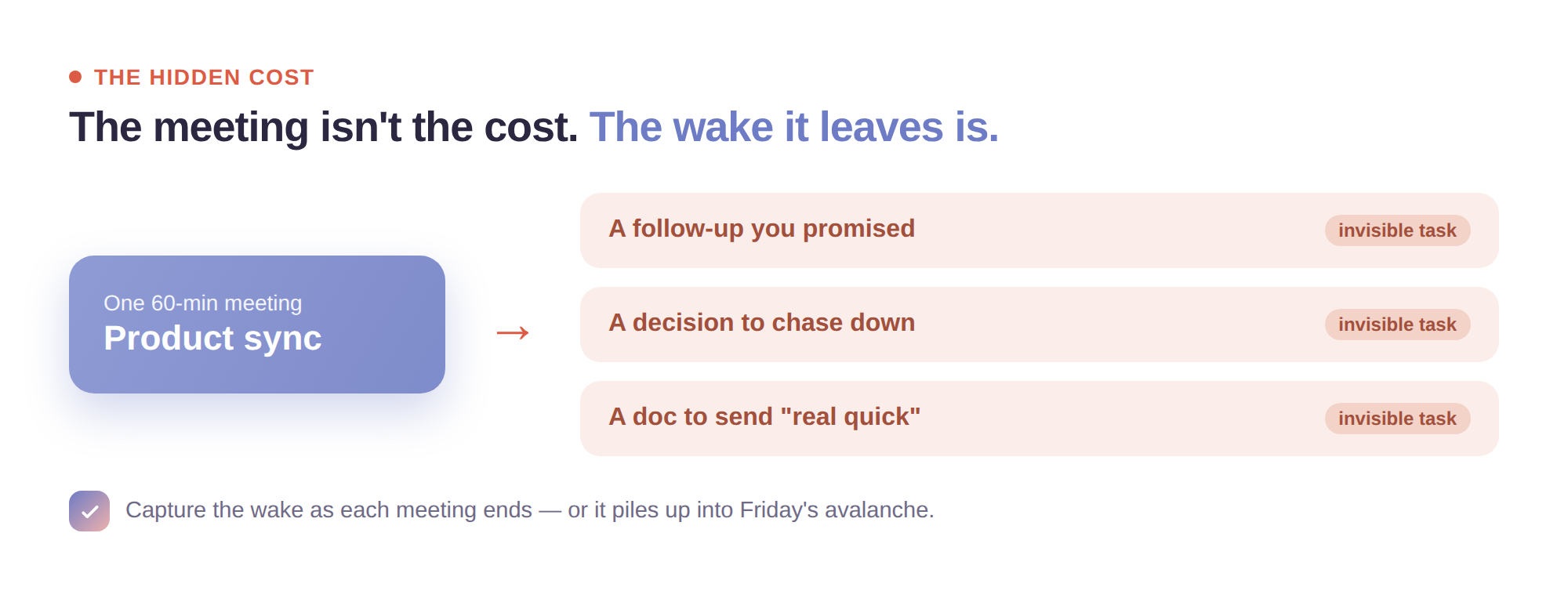
The real cost isn’t the meetings. It’s the wake they leave.
Count the hours in meetings and it looks bad enough. But the meetings aren’t the whole cost. Each one also generates work — a follow-up, a decision, a “let me send you that” — and leaves a smear of attention residue that makes the ten minutes after it nearly useless. That’s the hidden tax: not the sixty minutes in the room, but the invisible second shift the meetings create and the focus they fracture.
Which means the goal on a meeting-heavy day isn’t to squeeze deep work into the cracks — the cracks are too small and too broken for that. The goal is to stop the meetings from generating chaos: capture what they spawn, protect the one real gap you have, and recover your attention faster between them. Do that and a wall of meetings becomes something you ran, not something that ran over you.
Four moves for a meeting-heavy day
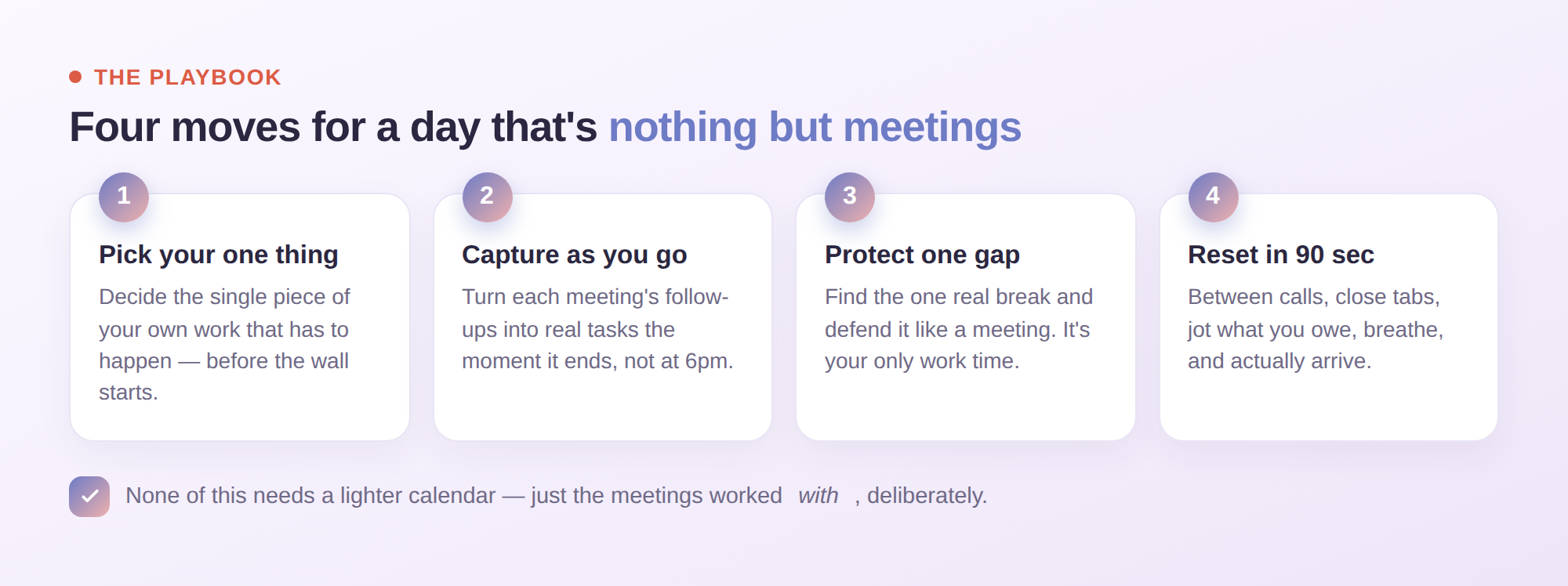
1. Decide your one non-meeting thing before the wall starts
On a packed day you will not do ten things. You might do one. So decide, before the first meeting, what that one thing is — the single piece of your own work that has to happen — and find the one real gap in the day to put it in. Everything else can wait for a lighter day. Naming the one thing is what keeps a meeting day from being a total write-off: even if the rest is other people’s agendas, one thing that mattered got done.
Try it in Sunsama: Set a daily priority and drag it onto the one open block you have, so it’s claimed before the meetings swallow the day.
2. Turn each meeting into tasks the moment it ends — not “later”
Every meeting leaves a wake: things you agreed to do, decisions to follow up, a doc to send. If you wait until the end of the day to reconstruct all of it, half of it is gone and the other half arrives as a Friday avalanche. Take thirty seconds as each meeting ends to capture what it spawned as real tasks with real homes. This is the single highest-leverage habit on a meeting-heavy day — it’s the difference between meetings that quietly pile up invisible work and meetings you’ve actually closed the loop on.
Try it in Sunsama: Capture follow-ups straight onto your plan as each call ends, so the day’s meetings don’t become next week’s backlog.
3. Protect one real gap — and defend it like a meeting
Look at the day and find the one genuine break — the 45 minutes between the 11:00 and the lunch call, say. That block is the whole game. Do not let it get filled by a “quick sync” or eaten by catching up on Slack. Put your one non-meeting thing there and treat the block as immovable, because it is the only real work time the day is going to give you. A protected 45 minutes used well beats four fractured ten-minute gaps every time.
Pro Tip: If you have any control over your calendar, defend the gap structurally — block it as a real timeboxed event titled like a meeting, not “focus (if I get to it).” A block with a name and a time survives; a vague intention gets colonized by the first person who needs you.
4. Recover your attention in the 90 seconds between calls
Back-to-back meetings don’t just cost time — they cost focus, because you carry the last conversation into the next one. You can’t add breaks that aren’t there, but you can reset in the seconds you do have. Before the next call, take ninety seconds: close the last meeting’s tabs, jot the one thing you owe from it, breathe, and arrive. It sounds small. It’s the difference between showing up to your 2pm actually present versus still half-arguing the point from your 1pm. Presence is most of what a meeting needs from you, and it’s the first thing a wall of them erodes.
The reframe: a meeting day isn’t a lost day
Here’s the mindset shift that matters most. It’s easy to write off a meeting-heavy day as a wash — to feel like real work only happens on the open days and these are just survival. But that framing guarantees the day is a loss, because you stop trying to get anything from it.
Instead, decide what a good version of a meeting day looks like: the one thing got done, every meeting’s follow-ups are captured and homed, you were actually present in the rooms that mattered, and you left without a pile of untracked promises. That’s a genuinely productive day — it’s just productive at meetings and their wake, which is real work too. Part of protecting it is getting comfortable saying no to the invites that don’t need you at all. Judge the day by that, not by how much deep work you didn’t do, and you’ll end it in control instead of behind.
None of this requires a lighter calendar. It requires treating the meetings — and the small spaces around them — as something to work with, deliberately, instead of a wall to brace against.
Start with tomorrow’s worst day
Look at your week and find the day with the most meetings. That’s the one to try this on. The night before, or first thing that morning, set your intention for the day: pick your one non-meeting thing, find the one real gap and claim it, and decide you’ll capture follow-ups as each meeting ends instead of at 6pm. Then run the day and see how different it feels to end a wall of meetings having actually gotten something — and owing nobody a forgotten promise.
The meetings probably aren’t going anywhere. But a day full of them doesn’t have to be a day you lose.