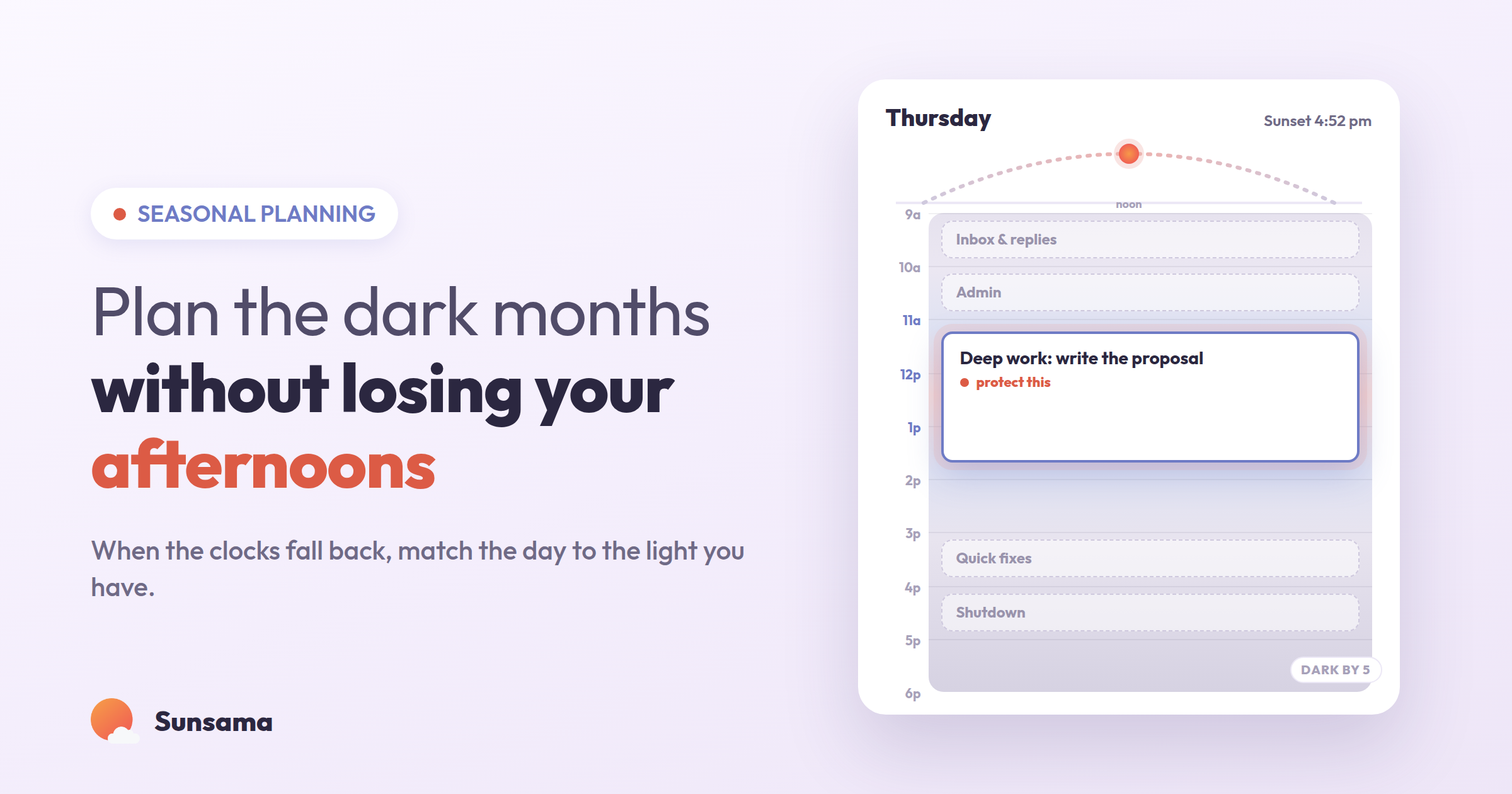
If you’ve noticed that your 4 p.m. has started to feel like someone else’s 6 p.m., you’re not imagining it. The light is leaving earlier every day, and on Sunday, November 1, 2026, daylight saving time ends and the clocks fall back an hour. The morning gets a little brighter for a few weeks, and then the afternoons go dark for the rest of the year.
Most of us try to pretend this doesn’t matter. We keep the exact same schedule we ran all summer — the same ambitious afternoon block, the same expectation that we’ll be sharp at 5 p.m. — and then quietly feel like we’re failing when the energy isn’t there. It isn’t a discipline problem. You’re trying to run a July plan on a November battery, and the plan is the thing that needs to change, not you.
The good news is that this is one of the most predictable shifts on the calendar. You know roughly when your energy will dip and when the dark will arrive. That makes it plannable. The point of this guide isn’t to squeeze more out of a shorter day. It’s the opposite: to help you build a calmer, more honest daily plan that fits the season you’re actually in, so the dark months feel like a different rhythm instead of a four-month-long disappointment.
Why the summer plan quietly breaks in winter
A daily plan is really a set of bets about your future energy and attention. In the long days, those bets are easy to win. You have natural light until the evening, your afternoons feel open-ended, and it’s simple to believe you’ll do deep work at 4 p.m. because, honestly, you often did.
When the light collapses into a short window, three things happen at once. Your useful hours get compressed toward the middle of the day. Your late afternoon shifts from “second wind” to “wind down” much earlier than it used to. And the dark outside makes the whole day feel longer and heavier even when the hours are the same. If your plan doesn’t account for any of this, it keeps writing checks your afternoon can’t cash. You end the day staring at three unfinished tasks that were never realistic for 4:30 in November.
The fix isn’t to lower your standards. It’s to stop planning against the season and start planning with it. That begins with being honest about capacity — the same muscle behind the official daily planning guide, just applied to a smaller, darker container of hours.
A calm way to plan the dark months
Here’s a six-part approach you can set up once and lean on from now through winter. None of it is about doing more. It’s about matching the work to the light and the energy you actually have.
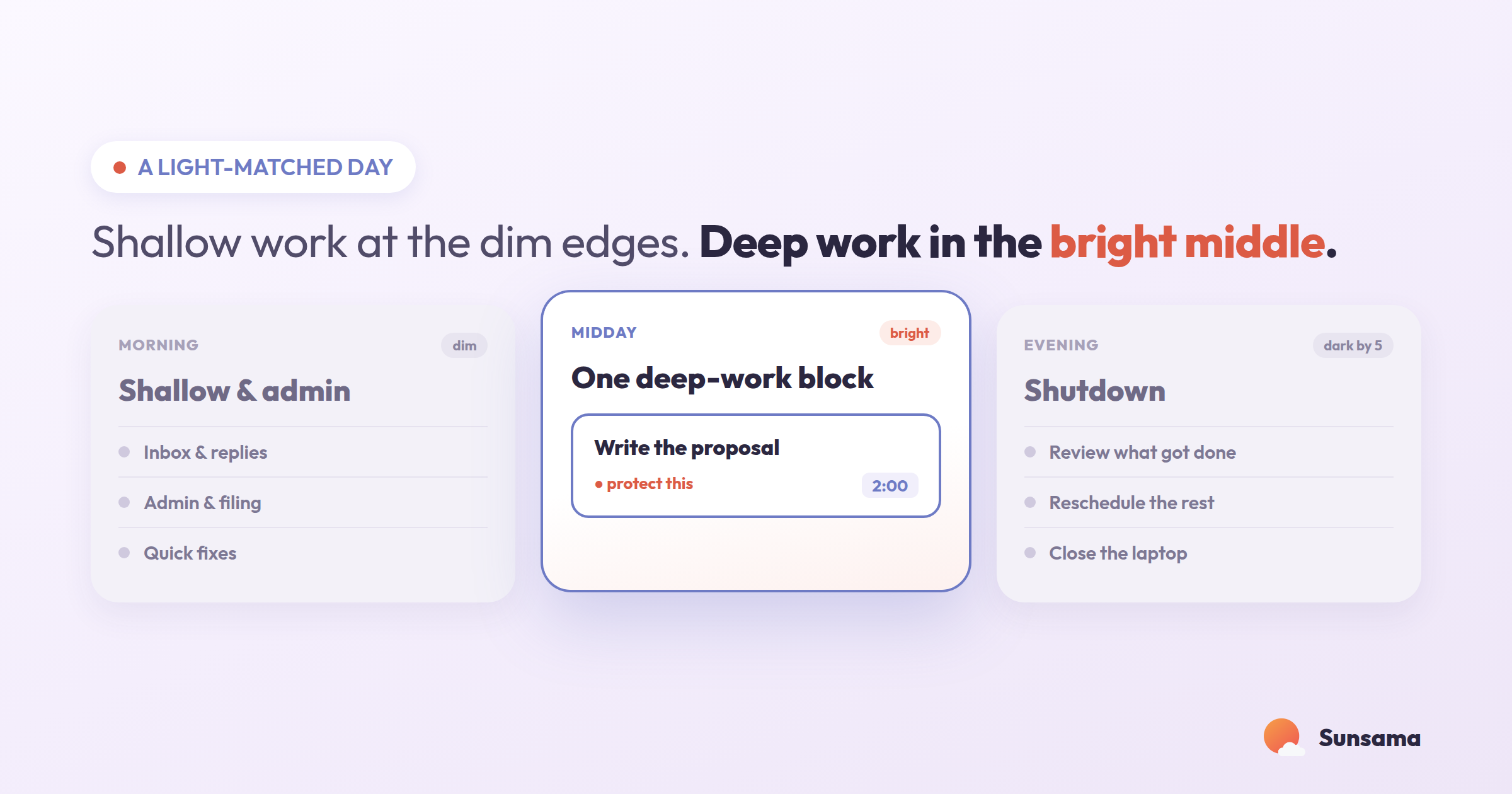
1. Protect the bright middle of the day for the work that matters. In the dark months, your best hours cluster into a shorter window — roughly late morning through early afternoon for most people. Treat that window as sacred. Put your one genuinely important task there, not at the edges of the day where the light and your focus are thinnest. This is the single highest-leverage change you can make, because it stops you from spending your best energy on email and saving your hardest thinking for the moment you have the least of it.
Try it in Sunsama: When you plan tomorrow, drag your most demanding task into the late-morning or early-afternoon slot on your calendar first, before anything else goes on the day. Build the rest of the day around that block instead of hoping it fits in later.
2. Set one intention for the day, not five. Short, dark days are not the time for a heroic to-do list. Pick the single outcome that would make the day a good one, and let everything else be in service of it or clearly secondary. Naming one thing does something quietly powerful: it gives you permission to stop at a reasonable hour and still feel the day counted. If you want a fuller method for this, how to set daily intentions walks through turning a vague “be productive” into a specific, finishable aim.
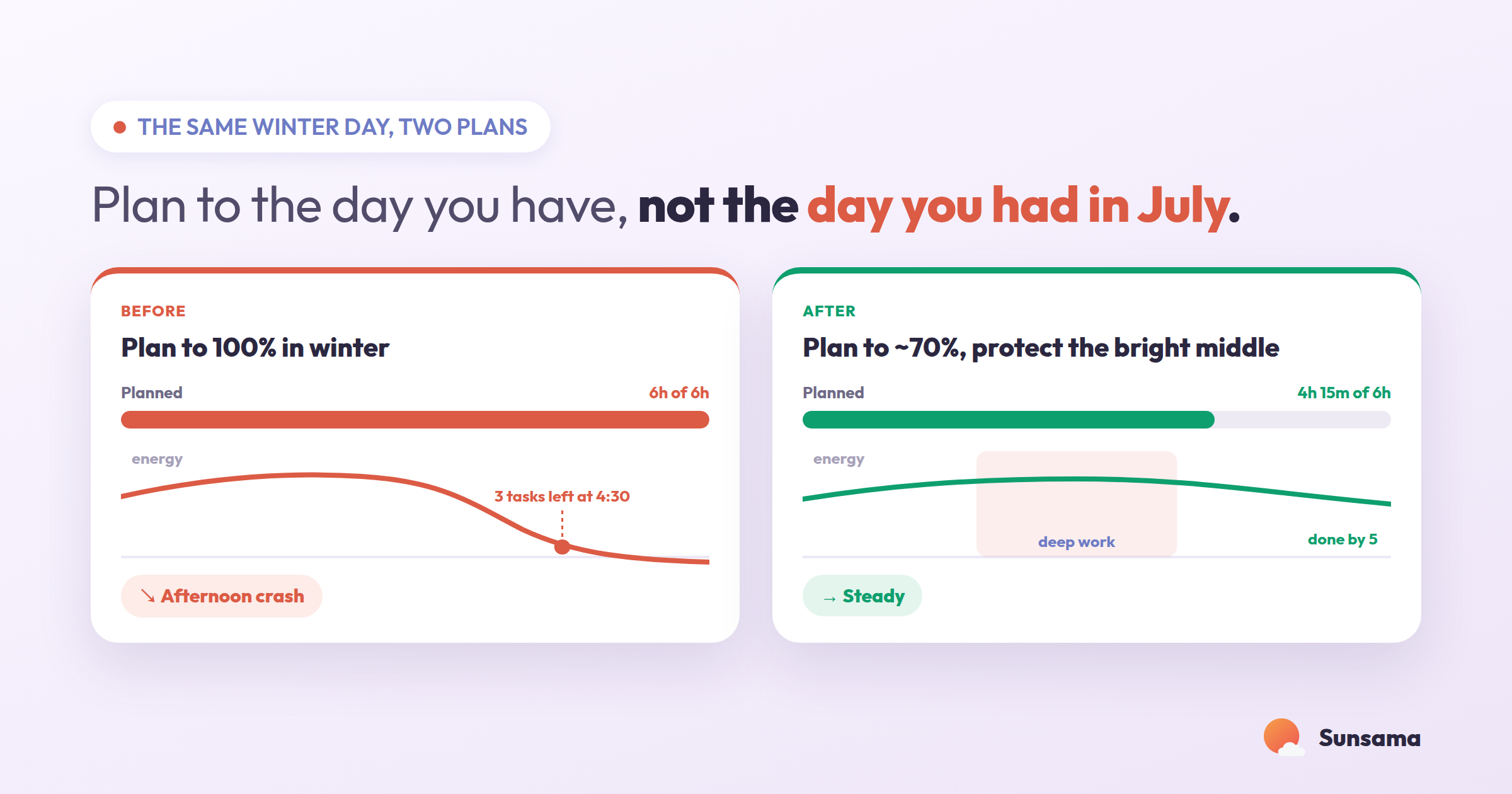
3. Plan to about 70 percent of your summer capacity. This is the number people resist most, and it’s the one that saves the season. You genuinely have fewer high-quality hours right now, so a day that’s planned full is a day that’s planned to overflow. Deliberately leave a third of your committed time unplanned. That buffer isn’t laziness — it’s where the afternoon dip, the slower start, and the unexpected thing actually go. A plan you finish by 5 is worth far more in November than an ambitious plan you abandon at 5.
Pro Tip: Don’t guess your winter capacity — measure it. For one week, note the time you actually stop doing focused work (not when you log off, but when your real attention runs out). That hour, minus a little, is your honest planning boundary for the dark months. Plan to it instead of to the clock.
4. Move the shutdown earlier and make it real. In summer, “end of day” drifts because the light lets it. In winter, the dark will try to make your workday feel endless — you look up, it’s black outside, and your body has no idea whether it’s 5 p.m. or 9. Pick a fixed end time and treat the darkness as a cue to close, not to keep grinding. A short, consistent wind-down where you review what got done and move what didn’t to a specific future day keeps the open loops from following you into the evening.
Try it in Sunsama: Set your end-of-day time a little earlier than your summer default and let Sunsama walk you through the shutdown: check off what’s done, reschedule what isn’t to a real day (not “later”), and actually close the laptop.
5. Batch the shallow work for the low-light edges. Not everything needs your peak hours, and that’s a feature, not a flaw. Email, admin, errands, quick replies, filing — the low-stakes work that still has to happen — is perfect for the late afternoon when your focus is naturally fading and the light is gone anyway. Stacking the shallow stuff at the dim edges of the day means you’re not wasting your bright window on it, and you’re not trying to do hard thinking when you’ve got nothing left. Time blocking is the simplest way to give these two kinds of work their own places on the calendar so they stop competing.
6. Review weekly and adjust as the light keeps changing. The dark months aren’t static — early November is very different from late December, and January has its own flat, post-holiday weight. A short weekly review is where you notice the drift and correct it: which afternoon blocks kept failing, what time you were actually useful until, where you over-committed again out of summer habit. Treating your plan as something you tune each week, rather than set once, is what keeps it honest all season. How to do a weekly review is a calm place to start if you don’t already have the habit.
The reframe: fewer good hours, not a worse you
It helps to name what’s really going on. You are not less capable in winter. You have a smaller window of high-quality attention, a body that wants to slow down when it’s dark, and a culture that pretends none of that is true. The disappointment most people feel from November through January isn’t about their output. It’s the gap between a summer plan and a winter day.
Close that gap and the feeling changes. A plan built for 70 percent capacity, anchored to the bright middle of the day, with one clear intention and a real stopping point, is a plan you can actually finish. Finishing is what makes a day feel good — not the length of the list. There’s a quiet dignity in matching your ambitions to your season instead of flogging yourself through it, and it tends to produce better work, because the important task got your best light instead of your last.
The dark months will come whether you plan for them or not. The only choice is whether your plan pretends it’s still July. When you let the plan change with the season, the short days stop feeling like a problem to overcome and start feeling like a different, slower, perfectly workable rhythm — one you get to keep for a few months before the light comes back.
Get started before the clocks change
You don’t need to overhaul anything. Before Sunday, do three small things. Pick the two-hour window that’s genuinely your brightest and decide that’s where tomorrow’s most important task goes. Choose one earlier end time for your workday and hold it for a week. And plan tomorrow to about two-thirds full on purpose, leaving real space for the afternoon to be slower than you’d like.
That’s the whole method: fewer commitments, placed in better light, with a real end. If you want a tool that makes this the default — one that asks you to plan tomorrow deliberately, pull only what fits, and shut down at a time you choose — Sunsama is built around exactly this kind of calm, honest daily planning. You can try it free for 14 days without a credit card and see whether the dark months feel different when your plan finally fits them.