You’ve tried them all. Bullet journaling. GTD. Time blocking. A new app every few months — the beautiful one, the fast one, the one with AI. Each time there’s a hopeful weekend of setup, a few good days, and then the same slow slide back to a cluttered list and a day that gets away from you. So you conclude the system wasn’t right, and you go looking for the next one.
Here’s the uncomfortable thing worth saying plainly: the search for the perfect system is itself a form of procrastination. It feels like progress — you’re “working on your productivity” — but researching, switching, and re-setting-up is a way of staying busy so you can avoid the actual work. The perfect system isn’t out there. And the hunt for it is quietly costing you the thing a system is supposed to give you.
Why the perfect system is a mirage
Every productivity system works in the demo and struggles in real life, for the same reason: the system isn’t the hard part. The hard part is the daily act of deciding what matters and doing it when you don’t feel like it. No app removes that. No methodology automates it. The best system in the world still requires you to sit down, look at your day, make some uncomfortable choices about what won’t get done, and then actually do the thing.
That’s why switching never fixes it. When a system “stops working,” it’s almost never because the system was flawed — it’s because you hit the part no system can do for you, and switching lets you feel like you’re addressing it without having to face it. A new app is a fresh hit of hope and a legitimate-looking reason to spend a weekend not doing your actual work. The tools get more sophisticated; the underlying job stays exactly as human and as hard as it always was. (It’s the same reason most task management quietly fails — the tool was never the missing piece.)
The switching costs nobody counts
System-hopping isn’t free, even though it feels productive. Each switch carries real costs.
The setup tax. Every new tool needs a weekend of configuration — importing tasks, building the perfect structure, learning the shortcuts. Multiply that by every app you’ve tried and it’s an enormous amount of time spent arranging your work instead of doing it.
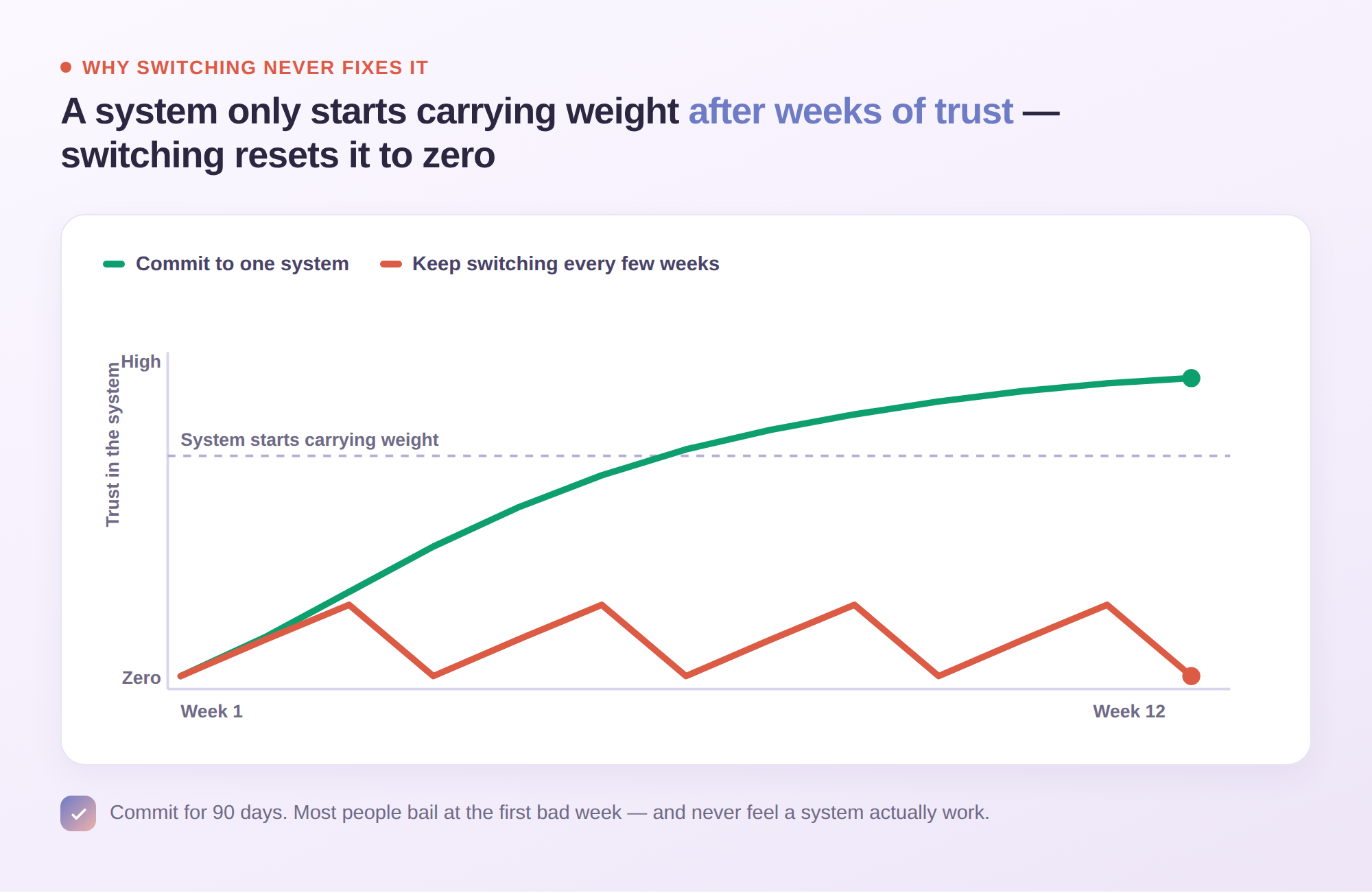
The trust reset. A system only works once you trust it enough to stop holding everything in your head. That trust takes weeks to build — and switching resets it to zero every time. If you’re always in the first weeks with a new tool, you never reach the point where the system actually carries the load.
The identity drain. Somewhere along the way, “finding the right productivity system” becomes a hobby that stands in for being productive. You can spend years as a connoisseur of methods and never ship the work the methods were for.
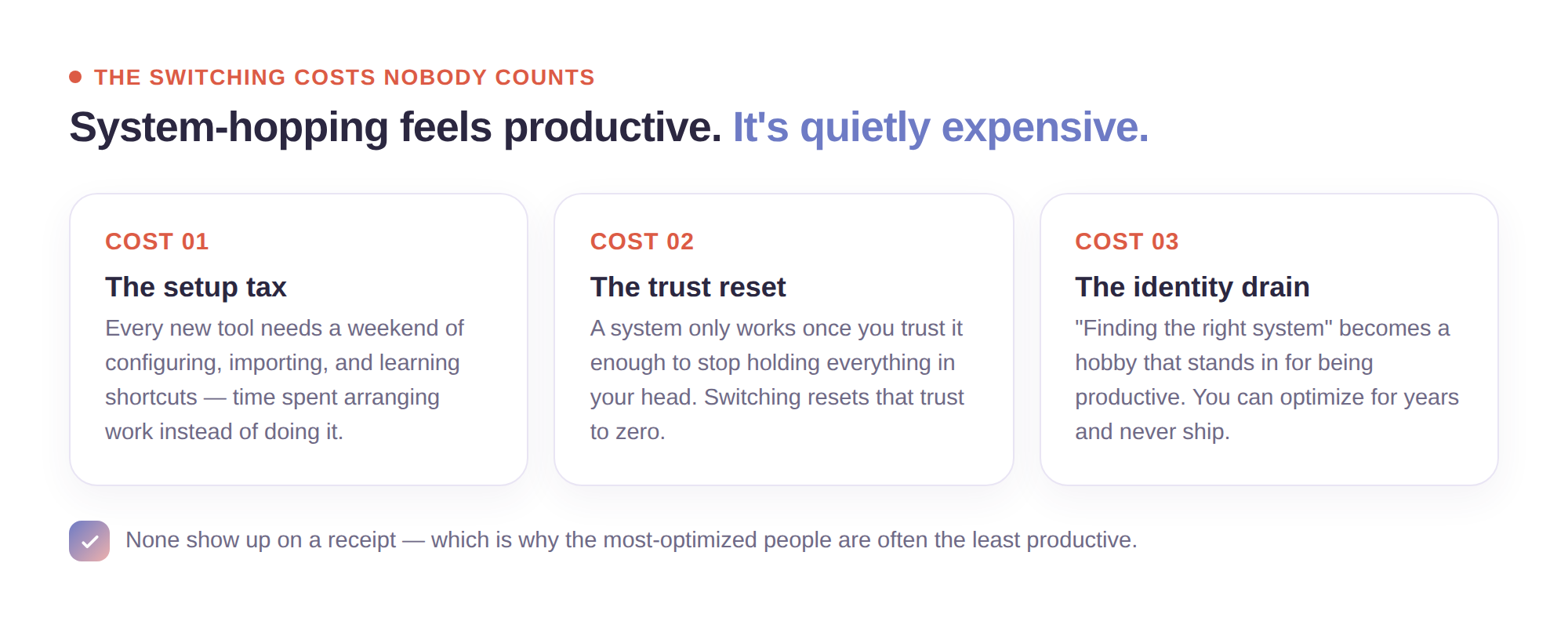
None of these show up on a receipt. But together they’re why the most-optimized people are often the least productive: all the energy goes into the meta-work.
What actually works isn’t a system. It’s a decision, made daily.
If the perfect system is a mirage, what’s the alternative? Something almost boringly simple: pick a good-enough setup and commit to the daily decision it exists to support.
The entire job of any productivity system is to help you answer one question every day — given everything I could do and the time I actually have, what will today be for? — and then protect that answer against the day’s noise. That’s it. A plain list and a calendar can do that. A fancy app can do that. What none of them can do is make the decision for you or force you to keep the habit. (This is the whole argument for why your day isn’t a project to be managed with heavier tooling — it’s a decision to be made, daily.)
So the winning move isn’t to find a better system. It’s to stop shopping, accept that your current setup is almost certainly good enough, and put your energy into the daily practice instead of the perpetual search. Boring commitment beats exciting novelty here, every time.
Try it in Sunsama: If you do want one place for the daily decision, keep it to that — plan your day against your real calendar each morning, and resist the urge to rebuild the system every few weeks.
How to get off the treadmill
If you recognize yourself in this, here’s how to stop.
Pick your setup and declare a moratorium. Choose a tool — the one you have is probably fine — and commit to it for ninety days, no switching allowed. Ninety days is long enough to get past the honeymoon and the first rough patch, into the part where a system actually starts carrying weight. Most people never stay long enough to feel that, because they bail at the first bad week.
Downgrade your ambitions for the system, upgrade them for the habit. Stop trying to build the perfect structure. Build the smallest one that works, and pour the energy you’d have spent optimizing into simply doing the daily plan, every day, especially on the days you don’t feel like it.
Notice when “improving your system” is avoidance. The urge to reorganize, re-tag, or research a new app almost always spikes right when you’re avoiding something hard. Treat that urge as a signal: not “time to switch,” but “time to notice what I’m avoiding.” Then close the tab and do the thing.
Pro Tip: A useful test — if you’ve switched productivity tools more than once in the last year, your problem is almost certainly not the tool. Commit to what you have, and put the switching energy into a daily habit instead. The results will embarrass how much time you spent shopping.
The freedom in giving up the search
There’s a quiet relief on the other side of this. When you stop believing the perfect system is out there, you stop feeling like your struggles are a tooling problem you can shop your way out of — and you get to put that energy into the work itself.
The productive people you admire aren’t running some secret, superior system. They’ve almost all made peace with a good-enough setup and gotten obsessive about the daily practice instead. That’s the whole trick. Not a better app — a decision you make every morning and keep, on a system you stopped questioning long enough to let it work.
Stop looking for the perfect system. You already have one that’s good enough. What’s missing isn’t the tool. It’s the ten quiet minutes a day, kept.