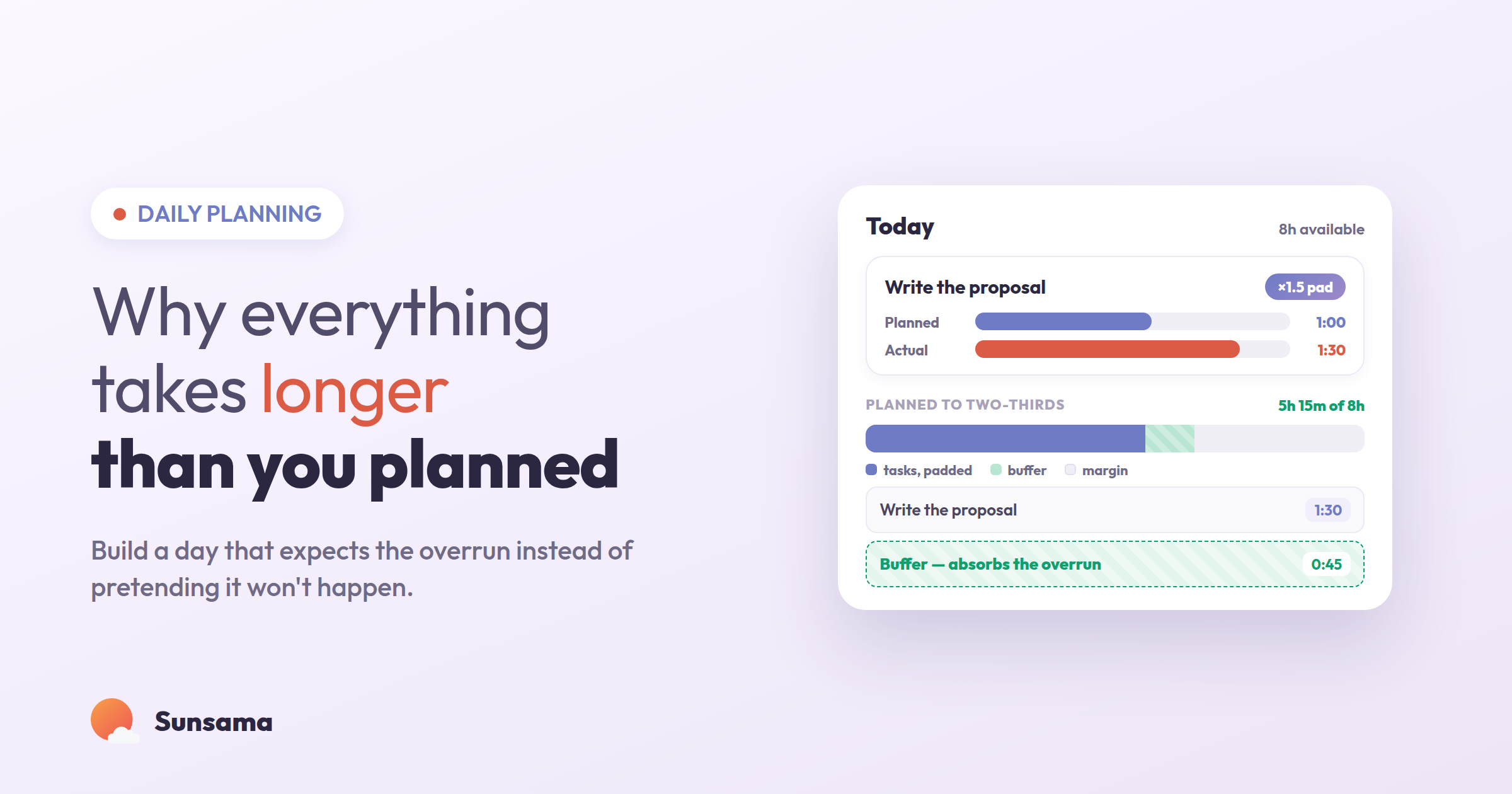
Here’s a small, humbling experiment. Before you start your next task, write down how long you think it’ll take. Then time it. Do that for a week and a pattern shows up that’s almost comical in its reliability: the thing you estimated at thirty minutes took fifty, the “quick email” became a twenty-minute negotiation, and the project you blocked two hours for is still open at the end of the afternoon. You are not bad at your job. You are human, and humans are systematically, predictably optimistic about time.
Psychologists have a name for this — the planning fallacy — and decades of research keep confirming it: we estimate how long work will take based on the smooth, best-case version in our heads, not the real version with its interruptions, second drafts, and “oh, I also need to...” detours. The fix is not to try harder to guess right. You will keep underestimating, because the bias is baked in. The fix is to stop building days that only work if your estimates are accurate, and start building days that expect them to be wrong. That’s a planning skill, and it’s learnable.
Why willpower and better estimates don’t solve it
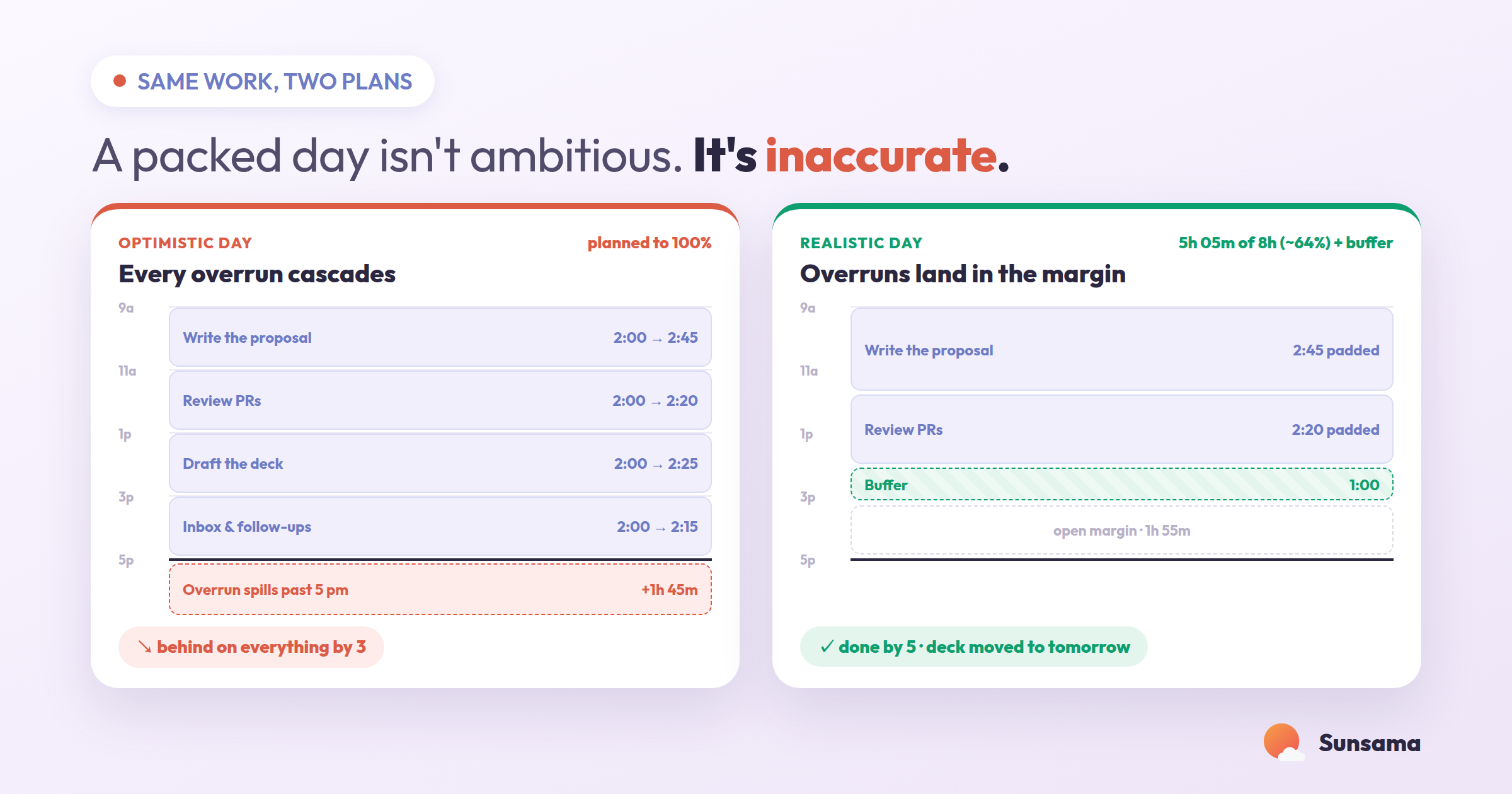
The common response to blown estimates is to resolve to be more disciplined — pack the day tighter, cut the “wasted” time, promise to move faster. This backfires, because the problem was never slack in the schedule. The problem is that a fully-packed plan has no room to absorb the overruns that are coming with near-certainty. One task runs long, and because there’s no air anywhere, the overflow cascades through everything after it. By 3 p.m. you’re not behind on one thing; you’re behind on all of it, and the plan is dead.
The second common response — just add more detail, estimate harder — fails for a quieter reason. Even careful estimates miss the stuff that lives between tasks: the context-switching, the reopening of a file you closed, the message that pulls you sideways, the ten minutes it takes to actually remember where you left off. These gaps are invisible when you plan and very visible when you live the day. A plan that only counts the work and not the seams between the work will always run short on time.
So the goal shifts. Instead of chasing an accurate estimate, you design a day with deliberate margin — one that stays true even when individual tasks behave exactly as badly as they always do.
A day that expects to be wrong: the method
This is a repeatable system, not a one-time fix. The point is to make margin structural so you stop relying on a good guess.
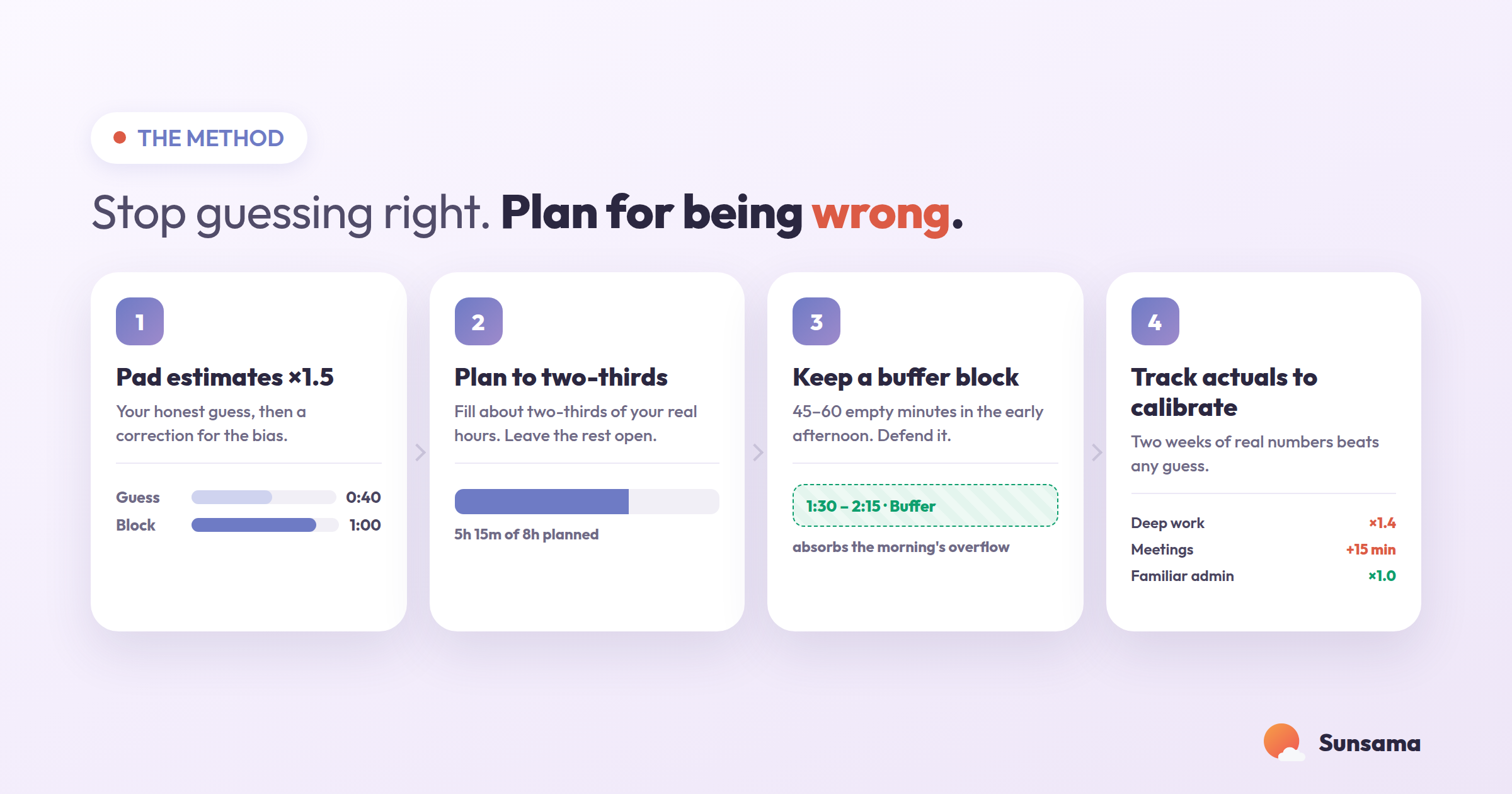
1. Plan to about two-thirds of your real hours, not all of them. If you have eight working hours, plan roughly five of focused task time and leave the rest unassigned. That remaining third isn’t wasted — it’s where the overruns, the small fires, and the unglamorous admin actually go. A day planned to 100% capacity is a day planned to fail at the first slip. This is the single highest-leverage change, and it feels wrong the first few times precisely because optimism tells you that you should fit more.
2. Estimate the task, then add a third. When you give a task a time estimate, make your honest guess — then multiply it by about 1.5. If it feels like forty minutes, block an hour. This isn’t pessimism; it’s correcting for a known bias with a known-ish multiplier. Over a week, watch your actuals and tune it. Some work (familiar, repeatable) needs almost no padding; some (creative, dependent on others, first-time) needs more.
3. Timebox the estimate onto your calendar. A number in a list stays abstract. The same estimate dropped onto your calendar as a block collides with reality — you can literally see that five tasks don’t fit in the afternoon you have. Time-blocking turns estimation from a guess into a constraint, and the constraint is what protects you from quietly overcommitting before the day even starts.
4. Name the one thing that has to be true today. Not the ten things — the one. When the day runs long (it will), this is the task you protect while everything else flexes. Setting a clear daily intention means an overrun costs you a nice-to-have, not the point of the day. Without it, every task feels equally urgent when time gets tight, and you make the worst trade: finishing small things while the important one slides.
5. Keep one unscheduled buffer block. Put a 45–60 minute empty block in the early afternoon and defend it. Some days it absorbs the morning’s overflow. Some days it’s genuinely free and you pull something forward. Either way it’s the pressure-release valve that keeps one long task from detonating the whole afternoon.
6. Re-plan once, midday, on purpose. Around lunch, take two minutes to look at what’s left and what time remains, and re-choose. This isn’t failure — it’s the system working. You’re trading a plan that’s now wrong for one that’s true again, while there’s still day left to act on it.
Try it in Sunsama: Set a recurring midday check-in and use it to re-plan the afternoon in Sunsama — drag what won’t fit to tomorrow before it silently blows up your evening. Moving a task on purpose at 1 p.m. feels completely different from discovering at 6 p.m. that it never had a chance.
Try it in Sunsama: Tonight or tomorrow morning, plan your day in Sunsama but only fill about two-thirds of your available hours with tasks, giving each one a time estimate padded by a third. Let the calendar show you when it’s full — and stop there, even if it feels too light. That “too light” feeling is the margin doing its job.
The quiet skill underneath: knowing your real numbers
Most people never close the loop between what they estimated and what actually happened, so they repeat the same optimistic guess forever. The antidote is cheap: track actuals for a couple of weeks. Not to judge yourself — to calibrate. You’ll learn that your deep-work tasks reliably run 1.4x, that meetings leak fifteen minutes of recovery time on each side, that Fridays hold less than you pretend. Those are your real numbers, and planning against them beats planning against the fantasy every single time.
A priority matrix helps here in a way that’s easy to miss: when you accept that you have less usable time than you wish, deciding what gets that scarce time becomes the real work. Time estimation and prioritization are the same skill wearing two hats — both are ways of admitting the day is finite and choosing accordingly.
The reframe: margin isn’t slack, it’s accuracy
It’s natural to see a two-thirds-full day and feel like you’re being lazy or leaving capacity on the table. Flip that. A day planned to the brim is not ambitious — it’s inaccurate. It describes a day that cannot happen. The two-thirds day is the honest one: it’s what actually fits once you account for the overruns, the seams, and the simple fact that you are a person and not an idealized worker in a scheduling diagram.
This is also, quietly, the anti-burnout move. The chronic low-grade stress of always being behind doesn’t come from having too much to do. It comes from a plan that promised more than the day could hold, so you end every day in deficit. Build the margin in, and you end days complete instead of behind — same amount of real work, radically different feeling. The official daily planning guide is built around exactly this: planning the day you can actually have.
Pro Tip: Once a week, in your weekly review, compare three numbers: hours you planned, hours of task work you actually logged, and how many days you hit your one must-do. If planned badly exceeds actual, you’re still estimating for the fantasy day — tighten the multiplier and shrink the plan. This five-minute check is what turns “everything takes longer” from a weekly frustration into a number you’ve learned to plan around.
Getting started
Pick tomorrow. Plan it to about two-thirds full, pad every estimate by a third, name the one thing that has to be true, and leave an afternoon buffer you refuse to fill. Then — this is the part that makes it stick — write down what each task actually took, without any judgment attached. In two weeks you’ll have your own real numbers, and planning will stop feeling like optimism punished by reality and start feeling like something you can count on. You were never bad at time. You were just planning for a day that was never going to show up. Plan for the real one, and it holds.
If you want the tool to carry the structure for you, Sunsama’s 14-day free trial (no credit card up front) is built around estimating, time-blocking, and planning to a realistic capacity — the whole method above, made into a daily habit instead of a thing you have to remember.